About 183 minutes
The Cruise of the Pelican — Key Ideas to Explore
Sea Voyages
41,968 recorded words. 14 minutes difference from this book's estimate.
View Gutenberg source #67311
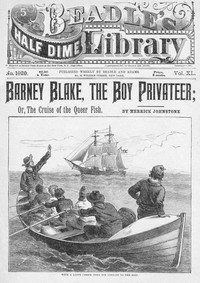
Barney Blake, the Boy Privateer; or, The Cruise of the Queer Fish — Inside the Classic can be approached with a clearer sense of reading commitment from its source measurements: 38,700 words, 2 hr 49 min estimated reading time, and 4 detected text sections.
The text analysis averages about 20.6 words per sentence, while the detected sections provide another way to judge how the source is divided.
Project Gutenberg metadata also associates the work with “Sea stories,” connecting these edition facts with the source record’s subject description.
Explore this collection
These alternatives are selected using recorded categories and estimated reading time.
About 183 minutes
Sea Voyages
41,968 recorded words. 14 minutes difference from this book's estimate.
View Gutenberg source #67311About 192 minutes
Sea Voyages
44,078 recorded words. 23 minutes difference from this book's estimate.
View Gutenberg source #72996About 222 minutes
Sea Voyages
51,038 recorded words. 53 minutes difference from this book's estimate.
View Gutenberg source #53796Search stored excerpts and compare books → Choose by your preferences →
Choices use stored catalog measurements. Estimates vary with reading speed. A shared category is a catalog label, not a claim that two books have the same argument or literary quality.
Search reads excerpt text stored with this catalog and links to its associated Gutenberg record. The connection is stored in the site database; this tool does not recheck that every excerpt is word-for-word identical to that external record. Excerpt search does not cover every chapter and does not verify historical publication dates.
Catalog snapshot checked: 2026-09-26. Coverage: 95 public books, 95 available source excerpts.
Calculated from edition completeness, EPUB availability, text structure and catalogue metadata. Not a user rating.
Total of 100 points, scaled to a 2.5-5.0 range. Editions with an empty description or a missing EPUB file are not scored.
Public-domain source text
The source text is kept in the dedicated reader, separate from this catalogue record and its commentary.
The narrator of Barney Blake, the Boy Privateer introduces himself with a sailor’s idiom: “Out of employment, with compass gone, and nothing to steer by.” This opening line establishes a colloquial, first-person voice that carries the entire story. The prose is built on brisk dialogue and nautical slang, with characters like Tony Trybrace and Old Nick speaking in clipped, salty exchanges. The narrative moves quickly through the recruiting scene and the comic bottle-overboard episode, but the pace changes markedly when the protagonist is stranded on Tierra del Fuego. There, the prose expands into a sustained, almost clinical description of a wolf attack, with careful attention to the narrator’s physical position and the wolves’ behavior. This shift from rapid-fire banter to a slow, tense survival sequence is the most striking structural feature of the excerpts.
The narrator’s voice is that of a Yankee tar, full of self-deprecating humor and practical observations. He responds to Tony’s hail with a metaphor: “compass gone, and nothing to steer by.” The dialogue is peppered with period nautical terms—flipper, r’yals, starn—and the characters are introduced through their speech and actions rather than description. Old Nick, for instance, is defined by his squint, red whiskers, and his comedic attempt to drink on the sly. The narrator’s tone remains consistent: he is an Everyman sailor, not a hero. Even when treed by wolves, he frames his predicament with ironic self-awareness: “Can you imagine anything more ridiculously lonesome and desolate than a Yankee tar treed in the middle of Terra del Fuego?” This vernacular consistency gives the book a unified, oral quality.
The excerpts reveal two distinct pacing modes. The opening chapters move rapidly through a series of short scenes: the wharf meeting, the boat ride, the bottle incident. Dialogue drives the action, and paragraphs are brief. In contrast, the wolf episode occupies a single, extended narrative block. The narrator describes his predicament in methodical detail: the height of the tree, the wolves’ leaps, his reloading process, and the gradual depletion of ammunition. Time is marked explicitly—“I remained six mortal hours a prisoner”—and the prose slows to match the narrator’s waiting. The rescue arrives with a sudden burst of action: “a loud shout of laughter” and volleys of musket fire. This alternation between quick, conversational scenes and prolonged, tense set-pieces is a deliberate structural choice, likely repeated throughout the novel.
The setting shifts from the bustling Boston wharves to the deck of the Queer Fish and then to a desolate Tierra del Fuego. The wharf scene is sketched lightly—a bright morning, a pointing hand—but the wolf episode is rich in sensory detail: the “prolonged, dismal howl,” the “villainous snap” of teeth, the sight of wolves devouring their own. The narrator notes the “running blood” and the “joyful yells” of the pack. These details ground the fantastic situation in physical reality. The tree is described as “low,” with the narrator’s feet swinging “only six feet from terra firma.” Such precision makes the peril feel immediate. The contrast between the generic shipboard setting and the vividly rendered wilderness suggests that the book’s most memorable passages are those that pause to observe the natural world.
Readers should approach Barney Blake as a series of episodic adventures held together by a consistent narrator. The voice is the book’s strongest element; pay attention to how the narrator’s tone shifts between self-mockery and earnest description. The wolf episode, though long, is a good example of how the author builds tension through accumulation of detail. The excerpts do not reveal the overall plot, but the pattern of quick dialogue followed by extended survival scenes is likely to recur. Treat the book as a period artifact of dime-novel storytelling, where pace and voice matter more than character development.
Reading that editor’s note on Barney Blake, I kept thinking of the quieter, salt-stained pages in The Second Mate — Context and Discussion. Herrick’s wolf attack lingers, but it’s the banter between hungry men between crises that feels most true. Perhaps every adventure is just a long pause between those moments.
Capture what you thought, learned, and would like to remember.