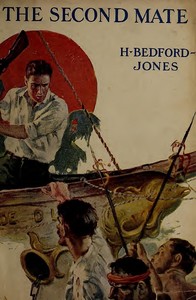
The Second Mate — Context and Discussion

(2 User reviews)   466
In Category - Sea Voyages
Bedford-Jones, H. (Henry), 1887-1949 Project Gutenberg 2019 Not confirmed
Sea stories; Seafaring life; Ships -- Fiction; Voyages and travels -- Fiction Readers of public-domain and historical texts
Project Gutenberg digital edition en

Edition facts

Words 22,840
Reading time 100 min
Text sections 3

For The Second Mate — Context and Discussion, the stored edition analysis reports 22,840 words, 1 hr 40 min estimated reading time, and 3 detected text sections.

The text analysis averages about 13.2 words per sentence, while the detected sections provide another way to judge how the source is divided.

Project Gutenberg metadata also associates the work with “Sea stories,” connecting these edition facts with the source record’s subject description.

An editorial note examining how H. Bedford-Jones uses shipboard hierarchy, tidal timing, and island geography to structure the action in 'The Second Mate,' a sea voyage adventure from 1922.
Share
Editorial Edition Score 4.5/5

Calculated from edition completeness, EPUB availability, text structure and catalogue metadata. Not a user rating.

How this score is calculated
  • Description quality20 pts
  • Title & short description10 pts
  • Source metadata20 pts
  • Text length15 pts
  • Chapters / structure15 pts
  • EPUB file integrity20 pts

Total of 100 points, scaled to a 2.5-5.0 range. Editions with an empty description or a missing EPUB file are not scored.

Edition quality

Read the Text

They were missionaries of some kind in China, had been ordered to voyage for their health, and as their funds were low, had taken the _Sulu Queen_. Jim Barnes had been too busy to ask questions. He would have welcomed them on the bridge, except that the Dutchman and the chief were both up there, nearly naked and rather soused. They had been there in that condition since leaving Cantop. When he explained the matter to them, Ellen Maggs blushed faintly, and Nora Sayers was quite willing to come along anyhow; but Ellen prevailed.

At two bells in the morning watch, Jim Barnes heaved a huge sigh of relief and left the bridge, which he had perforce held since before midnight. The islands were past; Simonor was dropping astern into the horizon and ahead was the open Celebes Sea and a clear course for Macassar. By some miracle the coral reefs had been evaded.

Jim Barnes sought the galley and obtained some tea from the yellow cook. He gulped it down and then started for his own cabin, meaning to get some sleep. The quartermaster of his watch had the bridge and a fair course.

Then, at the door af his stateroom, he paused with a sudden oath. The course was south by a quarter east; to his amazement, Barnes discovered that the ship was swinging around until the sun was almost astern.

With another oath of weary, wondering disgust, he started for the ladder. As he touched it, he heard his name spoken, and glanced around. The other quartermaster, Li Fu by name, was gliding toward him, and the yellow face was gleaming with inward excitement.

"What is it?" demanded Barnes.

"Maste', you watch out velly sha'p!" exclaimed Li Fu, low-voiced, tense. "Bad piecee bobbery kick up, mebbeso two bells this afte'noon! I think mebbeso all hands talkee-talkee make fo' mutiny. Cap'n he say fo' tell you come see him."

"You tell the skipper to go to hell," said Barnes. "Opium crazy, that's what he is. Mutiny. Good gosh, we've nothing to mutiny for!"

"Cap'n he say head in fo' Sesajap," persisted the Chinaman.

Jim Barnes groaned. "Head in for Sesajap, eh? Heading in for Borneo--the skipper changed the course, did he? That why we're turning?"

Li Fu nodded, beady eyes alert.

"Well, I've no time now to palaver with that cursed Eurasian topside," said Barnes bluntly. "You tell him to take the bridge or chase Vanderhoof up there--I'm done. Savvy? I'm going to sleep. Let everybody mutiny and be damned. I'm the only seaman aboard this cursed packet anyhow. I'm tired o' doing ten men's work. Trouble coming this afternoon, is it? Then let afternoon take care of itself. I'll be ready to take the deck after this watch is over--noon. And, listen! Tell the cap'n that if he don't shoot the sun and verify his position after this running around, he'll land us all in hell. You savvy that? Then tell him from me. And if he wants to run us into Borneo, let him do it!"

Li Fu grinned delightedly and stated that he savvied plenty. He, like any efficient seaman, had no use for the other officers and regarded Jim Barnes as a little tin god. Jim Barnes went into his cabin, locked the door, stuck a chair under the knob, and then dropped on his bunk, dead to the world.

Down in the engine-room, where the heat had sent the chief into a drunken stupor, the Malay serang conferred with the two assistant engineers. They were both men of color, being Macaense like the skipper, but not, like him, owning a large share in the _Sulu Queen_. Filling his mouth with betel paste, expectorating a scarlet stream across the floor under the ladder, the serang spoke as he squatted there with the two engineers.

"The supercargo, Lim Tock, is a very clever man. He has arranged everything into shares; there will be one hundred shares made of everything. Fifty of these will be divided among the men, the other fifty among us, the officers."

"Good," assented the second engineer. "How many are in it, Gajah?"

Gajah, the serang, spat again, and his soft eyes glowed luminously.

"All the men, here and above. The wireless man, the two quartermasters, _Tuan_ Barnes, and the cap'n must be killed. _Tuan_ Vanderhoof will navigate the ship. He is a great coward, and after his feet are burned he will be glad to serve us. This chief engineer must be killed, too. Six altogether. You will attend to this chief."

The two Eurasians looked at each other, then at the supinely snoring figure of the chief. They grinned and nodded. The chief would be drunk again after tiffin.

"You are sure of the men?" asked the third.

"Of course," said Gajah. "Lim Tock shipped them carefully at Canton, and my own men are picked for the purpose."

"Why has the course been changed?" demanded the second engineer.

"Because I whispered into the ear of the cap'n," said Gajah, with a meditative smile. "I told him that I knew a chief at one of the islands in the mouth of the Sesajap River, who had a great deal of gold dust, many birds' nests, and some fine pearls and shell. The _tuan_ cap'n is very greedy. He changed the course immediately."

"Is there such a man?" asked the third. Gajah grinned in derision.

"Why not? Once I knew such a man at Sibuko, which is not far away. He was the second cousin of my elder brother's third wife, and he was very rich. I went to visit him, and induced his youngest wife to run away with me. But she forgot to bring the pearls with her, being in love with me, and so I slew her. That happened in Manila, and they put me into prison because of it. The white _tuans_ did not understand."

"Well, when is this to take place?" asked the second engineer nervously.

"At the striking of two bells in the next watch."

"It shall be done. Who is to command, after that?"

"The supercargo, Lim Tock," answered the serang. "He is very clever. A friend of his, also a member of the Lim family, is to meet us near Bunju Island with a junk of which he is cap'n. Since the arrangement is all Lim Tock's, he deserves to command. It was he who got the opium put aboard at Macao."

"One thing," put in the third, his dark and muddy eyes gleaming. "The two white women! Surely they are not to be killed?"

"One does not waste the gifts of Allah," said Gajah sententiously. "The one with yellow hair goes to me; the other, who blushes often and whose figure is that of the willow, will comfort Lim Tock for the loss of his eldest son, who was hanged by the English last month for killing a white _tuan_. After a little while we shall sell them to chiefs along the coast, and so be rid of them. _Wallah_! It is hot down here."

He arose, knotted his fine silk _sarong_ more closely about his waist, loosened his shagreen-hilted kris in its sheath, and departed. They two engineers looked at each other, and a slow smile passed between them.

"She of the yellow hair," said the third reflectively, "is tall and strong, of high spirit, and a fitting mate for me, whose veins run with the proud blood of the da Soussas!"

"And she of the lissome body," said the second engineer, rubbing his bristly chin, "has ere now smiled very sweetly upon me. It is not proper that yellow and brown island scum should have precedence before us, men descended from the conquistadors!"

"I agree with you," responded the other. "But what are we to do?"

"First secure the ship," said the second promptly. "Then secure--what we want."

"Good!" agreed the third engineer with emphasis. "Let us consider the matter."

Meantime, in the chart-house Li Fu had delivered the second mate's message to the befuddled skipper, who sat dreamily over his charts. The message was literally delivered, but it could not stir the captain into action. He was lost in the reverie of contemplation that comes of good opium; not actual dreams, as some think, but a complacent sweetishness in the mind that shoves aside all immediate problems and refuses to take a crisis seriously.

The captain, indeed, was a lost soul. Usually your opium-eater cannot smoke the drug at all, and the smoker cannot attain Nirvana by eating it. This Macaense, however, both ate and smoked, thereby letting damnation into himself by two channels. He was a thin, pasty man, once of powerful physique, but now rather rickety on his pins.

"One hundred and seventy miles to the mouth of the Sesajap," he murmured. "We shall reach it at five o'clock tomorrow morning."

He gave over thinking and plucked vacuously at his thin mustaches.

"Providing the engines hold," added Li Fu, who spoke better Portuguese than English. "If the night is clear, there will be a new moon. We should sight the coast by midnight."

"The engines!" repeated the skipper. "Where is the chief? He was here an hour ago."

"He went below, sir. The mate woke up and went into the wheel-house."

"Bring him here, Li Fu."

The quartermaster went out of the chart-house, presently to return alone.

"He is asleep, sir. We cannot wake him."

"Drunk, eh? Never mind, never mind. I will take the observation myself at noon--

"And at two bells, sir," reminded Li Fu cautiously.

"Oh, you are a fool, Quartermaster! These men will not mutiny. There is no reason for it. You are not used to Lascars and must not be a fool. I shall go to rest and make ready my instruments. The course is to be held as it is."

The captain rose and, with a sigh of relief that no more duty presented itself, made his way back to his cabin.

Li Fu studied the outspread chart and lighted a cigarette. After a while, the other quartermaster left the wheel lashed and came into the chart-house, also lighting a cigarette. The two men greeted each other quietly. Like Li Fu, Quartermaster Hi John was a stalwart, efficient seaman, calm and well poised. He addressed Li Fu in the Cantonese dialect.

"I told him," said Li Fu. "He went to sleep. He was very weary."

"Did you find out why the captain changed the course?"

"No. He thinks more about his _hap toi_ than about what I ask him. I woke up the chief and told him, but he was too drunk to understand. He asked if there was no help for the widow's son, and went to sleep again. His mind is gone."

"The second mate will fight," said Hi John thoughtfully.

"If he is not slain before he gets a chance."

"There remains the wireless officer."

The two men looked at each other and smiled mirthlessly. The wireless man was the privileged son of a Macaense, chief owner of the _Sulu Queen_. Cumshaw had obtained his berth; he did not know one end of the wireless from another, as the quartermasters had learned when Jim Barnes cursed him for an idiotic fool. He was no better than an idiot; he was, indeed, some degrees worse, since the diseased degeneracy of Asia was his heritage.

"Then you and I are alone," said Hi John.

"We are alone. What answer shall we make to Lim Tock when the time comes?"

Hi John extinguished his cigarette.

"Duty is a shining star, Li Fu. I have a revolver in my bag."

"I have one also," said Li Fu. "Yet I do not want to swallow gold."

"Nor I; this life is good." Hi John lighted another cigarette. "Still, consider duty! Lim Tock is a terrible man. It was he who sank the Dutch steamer last year, before his son was hung. His son helped him. They each got two Dutch women and much money. If we do not join him, Li, I think that we shall both swallow gold."

"Yes. Then you join him."

"Oh, no." Hi John's singsong tones were soft. "Oh, no! I did not mean that."

Li Fu looked slightly ironic. "You think this ship worth dying for? Or those white women beautiful enough to die for?"

"Not at all," said Hi John. "The ship is a rotten hulk. The women are ugly and pale as ghosts. I care nothing what becomes of either. At the same time, I revere the wisdom of my paternal parent, who was also an officer in a ship. Before he swallowed gold, he asked me to take an oath, that I would never swerve from my duty. Therefore I cannot well join Lim Tock, since I undertook a certain duty aboard this ship."

"That is true," said Li Fu. "I have no oath to restrain me, but my duty needs no oath. Therefore I agree with you fully. I shall get my revolver, and also yours, while you are on the bridge; I have had it two rice-years, but it is a good one."

"Very well," said Hi John. "Give me mine when you have the opportunity."

While these two men talked on the bridge-deck, Lim Tock, the super-cargo, walked aft on the main-deck, past the dingy passenger-cabins where the brood of Abdullah swarmed about the two "missionary ladies." Lim Tock was an elderly Straits Chinaman, with a short, gray mustache, a drawn, parchment face, and two bright and glittering gray eyes--a most amazing pair of eyes to be staring from a saffron face! Yet some Chinese are gray-eyed.

In the stern, he came upon Abdullah, the Arab merchant, who was reading a Koran. The Arab looked up, smiled slightly, and spoke in the Low Malay which most men use in the island seas. This Slave of God was a thin and deadly looking person, fierce with his hook nose and jutting shreds of beard and jetty eyes.

"It is arranged," said Lim Tock. "You agree to take the white women off our hands?"

"Yes; and to ask no other share of the rewards."

Lim Tock inclined his head and passed on around to the starboard passage. There he came upon Gajah, the serang, busy doing nothing. To him Lim Tock spoke in High Malay, a tongue which very few men know or understand, even in the island seas.

"Abdullah suspects nothing. His boxes will be rich plunder. Let him be the first to fall, and his children after him--a clean sweep."

"And the woman, his wife?" asked the Lascar serang.

"She has borne many and is past pleasing. Let her accompany Abdullah."

The serang nodded indifferently and Lim Tock went his way.

While men thus talked and schemed and counseled together alow and aloft, Jim Barnes slept.

Nora Sayers was tall and active, with brilliant yellow hair and very deep violet eyes; a young woman of great energy, who had seen too much bloodshed in the revolutionary fighting around Pekin, and who had turned her mission station into a hospital of tortured men. Ellen Maggs, smaller, very slender and frail in looks, was newer to China, but she, too, had seen so many horrors that the powers above had thought best to send both women away on a sea voyage in company. Ellen Maggs, however, had more steel beneath her quiet and old-fashioned exterior than men imagined possible.

When they entered the mess saloon at eight bells, noon, they were not surprised to find themselves alone. They had by this time grown used to the peculiar conditions prevailing aboard the _Sulu Queen_. The chief had a lurking sense of shame that kept him from their presence. The captain had the bridge. The wireless officer came in, bowed very effusively, and seated himself. He could speak no English, and listened staringly to the laughter and light chatter of the two women. Abdullah and his family ate by themselves.

Presently Jim Barnes entered, bathed and shaven and with his usual air of radiating high good-humor. Almost at the same moment came Vanderhoof, eyes bloodshot, walk unsteady, to seat himself with a grunt and absorb quantities of coffee and rice-curry. He gave Barnes a scowling regard across the table.

"Der cap'n say for you to take der pridge," he growled.

"Not me," said Barnes pleasantly. "Now that we've open sea ahead, you and he can do a little work, Van. Everything's galley-west aboard this hooker, and the watches might as well go with the rest."

The yellow steward set an open gin-bottle beside the mate, who poured a tumbler full, then glared at Barnes.

"By chiminy," he said, "d'you refuse to opey orders, huh?"

"You bet I do," said Jim Barnes, his eyes twinkling. "And if you know what's good for your health, Van, you'll sober up before you try to give me any. Savvy that?"

Despite the cheerful accent, something in the steady and level regard of the second mate caused Vanderhoof to drink down his gin without making any response. When he had emptied the bottle, he shoved back his chair and left the cabin.

"Well, ladies," said Barnes, "how do you find yourselves this morning? Rather warm last night. Did your fan work all right?"

"Quite, thanks," and Nora Sayers smiled. "Aren't you just a trifle independent with your superior officers, Mr. Barnes? I thought all sailors were very polite----"

Barnes grinned. "Oh, me and Van? Don't pay any attention to that, Miss Sayers. He was just trying to show his authority in front of you and Miss Maggs."

"Oh!" Nora Sayers laughed. "Isn't it mutiny to refuse to obey orders?"

"Not aboard this packet. The skipper has been hitting the pipe all morning and now he's got us headed slap for Borneo. Lord knows why; I don't."

Ellen Maggs smiled shyly.

"You're the most happily irresponsible person I ever met, Mr. Barnes," she said. "And so is this ship. Every voyage in her must be a delightful adventure, if it's like this one! Have you been with her long?"

"This is my first and last," said Barnes drily. "You can't say that you've enjoyed yourselves so far, can you?"

"I have, every minute of it!" exclaimed Ellen Maggs, an unwonted sparkle in her eyes.

"And so have I," asserted Nora Sayers with energy. "Look at the queer people we've met! This funny little man down the table, who stares and giggles----"

"He's part idiot," interjected Jim Barnes. "But who else?"

"All of them! The poor old captain, with his politeness and queer abstractions and----"

"The old man's only forty," and Barnes chuckled. "But the hops gets 'em early. So you like the Eurasians, do you?"

"I don't like them, no, but they're interesting," stated Miss Sayers. "And the chief engineer is queer, too, only he won't talk--=="

"I was talking with him early this morning," put in Ellen Maggs. "He's a dear old man, Nora. He was telling me all about his early life in Scotland."

"He always does," put in Jim Barnes, "when he's in the middle of a big spree. Oh, don't look shocked! Won't do any good. I guess you ladies are disappointed that you didn't find another queer duck in the second officer's shoes, eh? Or am I queer, too?"

"You're just human," declared Miss Sayers promptly. "Only you're too busy to be very polite."

"I'm going to be busier yet, right after lunch," said Jim Barnes. "Oh, Steward! Get me some more of that curry."

"Why, what have you found now to keep you occupied?" asked Ellen Maggs, interested.

Jim Barnes did not respond until the steward had left the cabin. Then he spoke cheerfully, as he sugared his coffee with some care.

"Me? I've got to set the ship afire. As soon as they give the alarm, I want you two ladies to come up to the upper bridge-deck, and come quick! I'll be in the chart-house----"

"You mean that little coop up above the bridge, with the awning?" asked Nora Sayers.

"Just that. I'll get there before they discover the blaze."

The two women stared at him, then glanced at each other in perplexed wonder.

"What do you mean, Mr. Barnes?" demanded Ellen Maggs, a faint touch of color in her cheeks. "Are you joking about getting the ship afire?"

"No," said Jim Barnes. His tone was unusually crisp, and the look that he gave them was keen and incisive. "No. Don't let out a peep before the steward, now! A mutiny is due to start at one o'clock, and, so far as I can see, most of the officers will get wiped out at the first crack. Mutiny or piracy, I'm not sure which. I've got to set the hooker afire and keep the men so blamed busy they'll have no time for murder. Please pass the butter, Miss Maggs."

From its opening sentence, The Second Mate establishes a world held together by neglect and improvisation. The steamer Sulu Queen steams south with a tail shaft 'likely to go at any minute,' a drunken chief engineer, and a Portuguese Eurasian skipper lost in an opium dream. The ship’s decay is not merely atmospheric—it is the engine of the plot. The second mate, Jim Barnes, is the only competent officer aboard, and the story follows his efforts to keep the vessel moving and later to manage a castaway situation. Bedford-Jones builds the narrative around two distinct phases: the chaotic voyage and the enforced pause on a Borneo lagoon.

A Ship Held Together by a Single Man

The catalog of the Sulu Queen’s crew reads like a rogue’s gallery: a one-eyed chief engineer, a Malay serang who is an escaped murderer, a gin-rotten Dutch mate. Against this backdrop, Jim Barnes is the only figure who performs his duties without vice or incompetence. The text emphasizes his isolation by listing the failings of every other crew member before introducing him as the one 'for whose labor all these others drew pay.' This structural choice—delaying Barnes’s introduction until the ship’s decrepitude is fully established—makes his competence stand out sharply. The narrative voice is brisk and sardonic, noting that the Sulu Queen was 'certain not to be going for very long.' The reader is left with the impression that Barnes is not merely a protagonist but a one-man corrective to a system that has all but collapsed.

The Rhythm of Tides and Delays

Time in the novel is measured by the ship’s bells and the movement of water. After passing the islands, Barnes notes that the tide was on the ebb when they entered the lagoon, and now the boat is stuck until about five o’clock. This attention to tidal timing is not a minor detail; it structures the entire middle section of the story. The characters are forced to wait, and Bedford-Jones uses this pause to shift from action to observation. The women explore, the Chinese quartermasters cut bamboo spars, and Barnes sits smoking, studying the opposite shore. The narrative slows to match the characters’ enforced stillness. This rhythm—bursts of urgent activity followed by patient waiting—mirrors the pattern of a sea voyage, where nature dictates the schedule.

The Lagoon as a Stage for Character

Once ashore, the setting becomes a contained arena where personalities emerge through small actions. Nora Sayers is energetic and vigorous, immediately taking charge of the children; Ellen Maggs is more hesitant, her eyes 'big with wonder' and her speech marked by exclamation points. Barnes shifts from commanding officer to informal leader, joking about head-hunters and handing out tins of sardines. The lagoon itself is described as 'quiet,' 'cut off from wind and sea,' with the sun beating down 'blazing, torrential, insufferable.' This sensory detail contrasts with the earlier shipboard chaos and gives the characters room to interact without the pressure of immediate danger. The scene where the women and children go swimming around the point, their 'joyful shrieks' echoing, is the story’s most relaxed moment—and it is precisely this calm that makes the eventual departure feel like a return to uncertainty.

Movement Between Decay and Refuge

The novel’s structure depends on a clear spatial contrast: the failing ship versus the temporary haven of the lagoon. The Sulu Queen is described in terms of mechanical failure—loose plates, erratic list, barely adequate pumps—while the lagoon offers clean water, white sand, and bamboo for repairs. Yet Bedford-Jones does not romanticize the island. He mentions head-hunters and stingarees, and the tide that traps them is a reminder that nature is indifferent. The movement from ship to shore is not a rescue but a tactical pause. Barnes’s first act on land is to plan the boat’s re-rigging; his last thought before the women return is a frown as he studies the channel. The story’s energy comes from this constant forward pressure, even in moments of rest.

Readers approaching The Second Mate should pay attention to how Bedford-Jones uses the physical condition of the ship and the timing of tides to create tension. The novel is short—under 23,000 words—and moves quickly between scenes of crisis and calm. The excerpts suggest that the story’s interest lies less in exotic adventure than in the competence of a single man holding together a broken system. The lagoon sequence, in particular, rewards attention to small gestures and environmental details.

Rereading the notes on The Second Mate, I kept thinking about how Bedford-Jones measures time by tides and rank. It made me recall another quiet reckoning with order and salvage, where the wreck’s fate hangs on similar human and natural rhythms. That old feeling surfaced again — of being stranded between charts and weather. Salvage—extra special — Key Ideas to Explore carries a trace of that same patient waiting.

Dylan Hill
1 month ago

Charlotte Perez
2 weeks ago

4
4 out of 5 (2 User reviews )

Add a Review

Your Rating *
  • ...
    Christopher Kevin Simon - 4 weeks ago
    A brilliant nautical yarn that captures the essence of life at sea. The second mate's perspective offers a fresh take on the classic maritime coming-of-age story. The author's knowledge of sailing is impeccable, and the characters feel authentic. The narrative is both thrilling and introspective, making it a standout in its genre.

  • ...
    Andrew Jennings - 2 weeks ago
    A solid nautical adventure with a likeable protagonist. The descriptions of ship life are vivid, but the plot meanders in the middle, focusing too much on routine details. The conclusion is satisfying, though the antagonist lacks depth. A good read for those who enjoy old-fashioned sea stories.

  • ...
    Angela Malone - 1 week ago
    The premise is interesting, but the execution is problematic. The pacing is uneven, with long stretches of mundane activities that slow the story. The protagonist's internal monologues become repetitive, and the supporting cast is forgettable. While the ending tries to be dramatic, it feels forced. Not up to par with other sea adventures.


Reader reflection

Take a moment to reflect on this book

Create a short personal record of your experience with this book.

Your progress 0 / 10
1

Where are you in your reading?

2

What was your overall reaction to the book?

3

Would you recommend this book to another reader?

4

How demanding did the text feel?

Related eBooks