Life of Frederick Marryat — Inside the Classic
Edition facts
Before opening Life of Frederick Marryat — Inside the Classic, the edition data offers a quick orientation: 51,038 words, 3 hr 42 min estimated reading time, and 6 detected text sections.
The text analysis averages about 17.5 words per sentence, while the detected sections provide another way to judge how the source is divided.
Project Gutenberg metadata also associates the work with “Novelists, English -- 19th century -- Biography,” connecting these edition facts with the source record’s subject description.
Calculated from edition completeness, EPUB availability, text structure and catalogue metadata. Not a user rating.
How this score is calculated
- Description quality20 pts
- Title & short description10 pts
- Source metadata20 pts
- Text length15 pts
- Chapters / structure15 pts
- EPUB file integrity20 pts
Total of 100 points, scaled to a 2.5-5.0 range. Editions with an empty description or a missing EPUB file are not scored.
Read the Text
Frederick Marryat born 10th July, 1792; his parentage; his ancestry; home training; schooling at Enfield; runs away to sea; is sent into the navy and joins the _Impérieuse_ under Captain Lord Cochrane, in September, 1806 11
The naval war in 1806: the frigates of the Great War; Lord Cochrane, afterwards Lord Dundonald, Captain of the _Impérieuse_; his character; his influence on Marryat; the cruises of the frigate as described by Marryat in his private log; a narrow escape; Cochrane in the House of Commons; an affair in the boats; the Maltese privateer, Pasquil Giliano; movements of _Impérieuse_ 17
_Impérieuse_ on coast of Spain; cutting out privateer from Almeria Bay; alliance with Spain; Rosas; the Basque Roads; naval service of Marryat after parting with Cochrane till the end of the Great War; saves several men from drowning; various adventures; summary of his services from 1806 to 1815 31
Marryat’s position in 1815; goes abroad; marriage; appointed to _Beaver_; at St. Helena changes to _Rosario_; in Channel; pays off _Rosario_; the Channel smugglers; appointed to _Larne_; Burmese War; promotion and made a C.B.; transferred to _Tees_ in July, 1824; short command of _Ariadne_; the _Ariadne_ his last ship; resigns command November, 1830; begins writing; equerry to Duke of Sussex; story of William IV. 46
From 1830 to 1848 a writer; his literary life; expensive habits; early success in novel writing; editorial ventures; _The Metropolitan Magazine_; hard work in 1833-34; in 1833 he stands for Tower Hamlets, and fails; at Brighton in 1834; quotation from letter on lawsuit; goes abroad; life abroad; leaves for America 58
Marryat’s literary work up to 1837; his early success, and determination to make money; quarrels with publisher; prices paid him; “Frank Mildmay”; quotation from _Metropolitan Magazine_ on “Frank Mildmay”; other books from “King’s Own” to “Pirate” and “Three Cutters”; quality of Marryat’s style; quotation from “Peter Simple”; his plots; his fun; quotation from “Midshipman Easy” 73
Visit to America in 1837; his object in going there; in New York; letter to his mother describing where he has been; visit to Canada; affair of the _Caroline_; unpopularity in United States; Marryat stands his ground; return to England 98
Movements in London; ruin of West Indian property; life and friendships in London; Duke Street, Wimbledon, Piccadilly, Spanish Place; first signs of breaking health; goes to Langham; books of these years; “Phantom Ship”; children’s stories; “Masterman Ready”; skirmish with _Fraser’s Magazine_; Marryat defends publication of his stories in the _Era_ 114
Marryat goes to Langham for good in 1843; life there; Marryat and his children; kindness to his men; his scientific farming, and its financial results; his literary work; asked to write life of Collingwood; declines; last stories: “The Mission,” “The Settlers,” “The Children of the New Forest,” “The Little Savage” 132
His fatal illness; his _physique_ and personal appearance; letter to Lord Auckland on supposed slight; Hastings; loss of H.M.S. _Avenger_, and death of Marryat’s son, Lieutenant Frederick Marryat; returns to Langham; last months, and death on 9th August, 1848; estimate of his character and work 149
LIFE OF CAPTAIN MARRYAT.
Frederick Marryat, one of the most brilliant, and the least fairly recognized, of English novelists, was born in Westminster, on the 10th July, 1792, some seven months before the outbreak of the Great War. He was the second son of Joseph Marryat, M.P. for Sandwich, chairman of the committee of Lloyds, and Colonial Agent for the island of Grenada. His mother was a Bostonian, of a loyalist family. Her maiden name was Geyer--or according to Mrs. Ross Church’s life of her father, Von Geyer--and the family is said to have been of Hessian origin. The Marryats themselves were a Suffolk stock. In Marshall’s “Naval Biography,” which appeared during Marryat’s own life, the novelist is said to have descended from one of the numerous Huguenot refugees who settled in the Eastern Counties during the persecutions of the sixteenth century. The family version of its history, as given by Mrs. Ross Church, contains a longer and more splendid pedigree, going back even to knights who came over with “Richard Conqueror.” These things, though set forth with faith no doubt, are to be received with polite reserve by the judicious reader. For the rest, whatever the remote origin of the Marryats may have been, they were during the seventeenth and eighteenth centuries very distinctly middle-class people--dissenting ministers, doctors, or business men--manifestly of good parts and industry. Some of them wrote sermons and printed them. Thomas Marryat, the novelist’s grandfather, was a doctor and the author of a medical book. His father was, as the places he held show, a prosperous man; and the future novelist entered the world under fairly favourable circumstances. There was, it is clear, no want of money, and the family were active people with a marked tendency to use their pens.
As no detailed life of Marryat was written until long after his death, when no witnesses were left who could speak with knowledge, there is an almost absolute want of evidence as to the character and probable influence of his family life. If we are to argue from his stories, it was hardly to be called happy. These guides may not be entirely safe, and yet they afford evidence of a kind not to be lightly dismissed. A writer whose pictures of home and school life are habitually disagreeable, cannot have had many pleasant memories of his own to look back on. With Marryat this was the case. In all his earlier stories, and until he became decidedly didactic, and religious, in his later years, he described the relations of parents and children, of schoolboy and schoolmaster, as either indifferent or hostile, or as contemptuous even when affection is not absent. Peter Simple, Mr. Midshipman Easy, and Newton Foster are the sons of men whom they may like, but cannot respect, of whom two are maniacs, and one is a harmless imbecile. Their mothers are either utterly shadowy or repulsive. “Frank Mildmay,” the first and the most autobiographical of his stories, is also the most destitute of kindliness. Something may be allowed for rawness in the author, and something for direct imitation of the earlier Smollettian model. Marryat, too, publicly protested that he was not the “Naval Officer” of this first story. But, by his own confession, he put many of the incidents of his own life into it, and we may safely conclude that what is wholly wanting in the story was not prominent in his own experience. Now what is wanting is any trace that Frank Mildmay had the smallest filial regard for his father, or was conscious of any maternal influence, or thought of his home life with affection, or of his school as other than a place of torment. That is not how men write when they look back kindly on their first years. If Thackeray and Dickens drew such different pictures of boy and school life, we know why. It is not necessary to rack the scanty evidence about Marryat’s early years, to find reason for believing that his father was probably a hard and dry man of business, whose prosperity never melted the provincial dissenter quite out of him. Of his mother there is nothing to be supposed at all.
It is to be noted that although Mr. Joseph Marryat was a prosperous man, he did not send his sons to a public school. Frederick and his elder brother (Joseph also, and not unknown as a collector of, and writer on, porcelain) were sent to some sort of academy kept by a Mr. Freeman, at Ponders End. It is an almost universal experience that the boy who has been at a private school may remember an individual master with kindness, but never has any degree of respect or affection for the place itself. He is not one of an ancient body like the public-school man, and has nothing in his memory to set off against the restraint--or in the old hard days the floggings and hardships of school life. The Wykamite might laugh at the wash pot of Moab, but what private-school boy would forgive his master for turning him out to wash in a back yard? What is inflicted by a public school is inflicted by the school itself; in a private establishment it is inflicted by the master, and is a personal wrong. Marryat was no exception to the rule. His memories of Ponders End were not of a kind to make him draw cheerful pictures of school life. That he was far from a model pupil, and had his share of the cane, has nothing to do with it. He scamped his work, and forgot it, as many other boys have done and will do. Not only that, but he was the cause of scamping in others. Mr. Babbage, who was for a time his schoolfellow, is the authority for a story which shows that Marryat was indeed a model young scamp. Babbage wished to work (it does not appear whether they called it “sweating” or “greasing” at Ponders End), and to get up for that purpose with another “swot” at the absurd hour of three. With intentions which were only too obvious, Marryat, who was his room fellow, proposed to join the party. Babbage objected, and thought to escape the intrusion by the easy method of not waking Marryat. This answered until the creator of Mr. Midshipman Easy first bethought himself of drawing his bed across the door, and then when even the moving of his bed did not rouse him, of tying his hand to the handle. For some nights Babbage got over the difficulty by cutting the fastening, until Marryat found a chain which could not be cut. Babbage had his revenge. He invented an ingenious machine for jerking the chain, and went on waking his chum repeatedly for no purpose. At last a compromise was made. Marryat joined the good boys for early study, and of course it was not long before others joined too, and then the letting off of fireworks and various noises betrayed the secret. How many of the party were flogged does not appear. Before long Marryat had to be up at six bells in the middle watch on duty too often to leave him much inclination to turn out voluntarily, even for mischief, when he could by any chance get a night in.
It is also recorded of Marryat that he ran away to sea three times, that is, he ran away with the intention of getting to sea, but the end of the adventure was always capture, return to school, and more cane. His great grievance is reported to have been the obligation to wear the clothes which his elder brother had outgrown. The detail seems to indicate a certain narrowness, not to say sordidness, in so prosperous a household as the Marryats’, and the aggravation was certainly gross enough to justify the protest. On one of these occasions Mr. J. Marryat showed a remarkable weakness. He gave the truant money and sent him in a carriage back to school. This error of judgment had a very natural consequence. Marryat slipped out of the carriage, found his way quietly home, and took his younger brothers to the theatre. At last his father came to the very sensible conclusion that the sea was the best place for such a boy. Being a man of some influence and position, he was able to start his son well, on board a crack frigate, and under a distinguished captain. In September, 1806, Marryat entered the _Impérieuse_, captain Lord Cochrane, and sailed for the Mediterranean.
Fortune could not have done Marryat a greater kindness than to send him to sea on the quarter-deck of the _Impérieuse_. She enabled him to share in the most stirring work to be done at the date at which he joined the service, and under the command of one the most brilliant of naval officers. In 1806 the war of fleets was over. Trafalgar had broken the heart of our enemies, and from that time forward their squadrons never even attempted to keep the sea. Napoleon built line-of-battle ships in batches, but only to keep them manned and armed, lying idle in port. The English fleets had so completely established their supremacy, that they used the French roadsteads as familiarly as their own. The blockading squadron off Brest anchored in Douarnenez Bay, in sight of the French lookout, and there repaired their rigging or caulked their seams as coolly as if no enemy’s fleet were in existence, and they did it with perfect impunity. Admiral Smyth has told how audaciously the Mediterranean fleet was wont to anchor off Hyères in the absolute confidence that the French would never come out of Toulon. Their only chance of service was when the French would be decoyed out by some particularly audacious frigate, which was sent in to insult them at the very mouth of their harbour. Then there was a chance that they might be drawn further than they could go back before the in-shore squadron was upon them. But such breaks in the monotony of blockade were rare. For the most part our line-of-battle ships were employed in cruising to and fro, with intervals of harbour--their officers and crews spent their lives in drilling aloft or at the guns, and in keeping decks and metal-work in a condition of faultless cleanliness. That passion for neatness and smartness which has never left the British navy rose to its height in the last years of the Great War, and did indeed sometimes attain to actual mania in the minds of captains and first lieutenants in want of something to employ themselves and their men upon.
There was, however, one class of ship which had a fair chance of active service. The frigates were never, even to the end, reduced to mere patrolling. It was to them indeed that fell all the brilliant fighting in the last ten years or so of the war. The French never altogether ceased to send forth cruisers which had necessarily to be pursued and captured. Moreover, there was work to be done upon the enemy’s coasts, convoys to be taken, forts to be destroyed, privateers to be cut out. After 1808 we were in alliance with the Spaniards, and there was then no want of chances for enterprising officers to distinguish themselves against the French invaders on the coasts, particularly in the Mediterranean. The Mediterranean, including the Adriatic, and the East Indies, were the great theatres of the war until the Americans struck in.
It was a material addition to his good fortune in being appointed to such a ship, and on such service, that he should have begun under the captain who then commanded the _Impérieuse_. The novelist who was to give the most living of all pictures of the navy at its greatest time could not possibly have met with a better chief. Lord Cochrane, who is better known as the Earl of Dundonald, was, next to Nelson (the master of them all), that one of the naval officers of the Great War who was most distinctly a man of genius. There were others who were brave, able, honourable gentlemen. In pure seamanship many may have been his equals. In a service which included such men as Blackwood, Hallowell, Willoughby, the Captain Hamilton who cut out the _Hermione_, Broke of the _Shannon_, and a hundred other valiant gentlemen, even Dundonald could not hope for a pre-eminence in valour. It may even be allowed that he never, while fighting for his own country, was able to achieve anything so complete, so distinctly what Cortes called a “muy hermosa cosa,” a very pretty piece of fighting with a squadron, as Sir William Hoste’s little gem of a victory over the French frigates off Lissa. He was not allowed the chance to handle a detachment of ships in independent command. But there was in Dundonald the indefinable something--“those deliveries of a man’s self which have no name,” that combination of passion and faculty--which makes the man of genius. Whatever he did was done with a burning fire of energy. The fire was not always pure. There was a self-assertion about the man--never base, but always aggressive, a pragmatical Scotch fierceness, a love of hate and scorn, a total inability to keep measure, which can be seen on every page of his Autobiography, and explain why it was that he was always, in our service or out of it, a free lance. He was of the race of Peterborough not of Marlborough. To the highest rank he did not belong, but he was divided in kind from the brave, able, disciplined, but shadowy men, who do the regular drilled work of the world. He was a magnificent, rugged individuality. Even in books he is real as only such men as Nelson and Wellington are real. On those who knew him his influence, even if it only produced repulsion, must have been profound. One so open to impressions, and so able to retain them as Marryat, must have been another man all his life for having known and admired Dundonald. It must be remembered, too, that Marryat saw Dundonald at his best--on the deck of his frigate, and not at the Admiralty or the House of Commons, where he was apt to make himself intolerable by his wrong-headed violence in right, and his inability to see that for the work of the reformer, as for all work, there is a proper time, and a fitting manner which must not be mistaken, under penalty of failure.
The influence which Cochrane had upon Marryat might indeed be demonstrated from his works. The captain of the _Impérieuse_ remained his type of what a British officer ought to be. All his frigates’ captains who are mentioned for honour have something--and several of them have much--of his first commander in them. That this should be the case in “Frank Mildmay,” the first of his books, and to some extent an autobiography, was almost a matter of course. In this book the cruise of the frigate on the coast of Spain is the very service of the _Impérieuse_. But it is equally true of Captain Savage of the _Diomede_ in “Peter Simple,” and of Captain M---- of the “King’s Own.” Both are Scotchmen, penniless gentlemen of good descent, officers of boundless skill, daring, and withal judgment. It is on this last quality that Marryat dwells by preference, and it is this which he picks out for special praise in Cochrane. “I must here remark,” he says in the private log quoted in Mrs. Ross Church’s life, “that I never knew any one so careful of the lives of his ship’s company as Lord Cochrane, or any one who calculated so closely the risks attending any expedition. Many of the (_sic_) most brilliant achievements were performed without loss of a single life, so well did he calculate the chances; and one half the merit which he deserves for what he did accomplish has never been awarded him, merely because in the official despatches there has not been a long list of killed and wounded to please the appetite of the English public.” This fondness of the public for a long list of killed and wounded was a favourite subject of half-serious jest with Marryat, and he learnt from others, if not from Cochrane, how a despatch ought to be written in a “concatenation accordingly.” It would seem that Marryat had little admiration for the brainless, headlong courage which rushes madly at whatever happens to be in front of its weapon. He would have condemned even with contempt (and Hawke, Nelson, Cochrane, would have condemned with him) such a piece of frantic swash-bucklery as the last fight of the _Revenge_. The men who were daring with judgment, who risked for a reason, who took care to cover themselves as they lunged, and who then went all together, sword, hand, and foot, with the speed of lightning, and with unerring accuracy of the eye which has brains behind it, were his heroes. In any case Marryat would have arrived at these conclusions, but he assuredly did so the sooner, and the more heartily, because for three years he fought under a fighter of this stamp.
Marryat was fortunate in his messmates as well as in his captain. A crack frigate of those days had the pick of the lieutenants’ list, and of the “young gentlemen” who were to be the captains of the future. The _Impérieuse_ had a particularly good staff, some of them old officers of Cochrane’s, and in the midshipman’s mess Marryat met comrades who were good fellows, and gentlemen too. He formed friendships which lasted through life, particularly with Lord Napier, and with Houston Stewart.
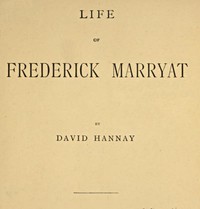
David Hannay opens his biography of Frederick Marryat by acknowledging the scarcity of source material: 'The materials for a life of Marryat are scanty,' he writes, relying on Mrs. Ross Church's 1872 collection of family knowledge. Hannay's stated aim is to tell 'what story there is to tell in the clearest possible manner' and to offer an estimate of Marryat's work and position in letters. The biography traces Marryat from his birth in 1792 through his naval service under the formidable Captain Lord Cochrane aboard the Impérieuse, his later commands, and his transition to a literary career after 1830.
Naval Foundations and Cochrane's Influence
Hannay devotes substantial space to Marryat's formative years at sea, particularly his service under Lord Cochrane. The biography describes Cochrane's character and his influence on Marryat, noting that the cruises of the Impérieuse were later described by Marryat in his private log. Specific episodes include a narrow escape, an affair in the boats, and the capture of a Maltese privateer named Pasquil Giliano. Hannay also records Marryat's own acts of heroism, such as saving several men from drowning. The narrative moves through the Basque Roads action and the end of the Great War, providing a concrete sense of the naval world that would later populate Marryat's fiction.
Literary Career and Editorial Ventures
After resigning his last command in November 1830, Marryat turned to writing. Hannay notes his early success in novel writing and his editorial ventures, including The Metropolitan Magazine. The biography mentions that Marryat worked hard in 1833-34, stood for Parliament in Tower Hamlets (and failed), and lived at Brighton before going abroad. Hannay presents Marryat as a writer with expensive habits, yet one who managed his literary business shrewdly. The account is grounded in specific details—such as a quotation from a letter about a lawsuit—rather than broad generalizations about his literary merit.
American Sojourn: Observation and Commerce
Hannay's treatment of Marryat's 1837-38 American tour is notably detailed. He describes how Americans, wary of foreign commentators, were 'intent to know whether Marryat meant to write about them.' Marryat navigated this with dexterity, keeping on friendly terms while observing copyright institutions and their effects. Hannay includes a letter from Marryat to his mother, written from a steamer on Lake Erie, recounting a journey of 'some thousand miles' by lake and canoe, including five days in a bark canoe on Lake Superior. The biography also records a business arrangement with Carey and Hart for advance proof sheets of his 'Diary in America' and 'The Phantom Ship' for $2,250, with a possible bonus of $250—evidence of Marryat's 'usual turn for business.'
Hannay's biography, though necessarily reliant on published materials, offers a compact, evidence-based portrait of Marryat's dual life as naval officer and man of letters. Readers interested in the interplay between Marryat's sea experience and his fiction will find the early chapters particularly valuable, while those curious about the business of authorship in the 1830s will appreciate the American episode. The book is best approached as a concise introduction rather than a definitive life.
Marryat’s restless years, chasing both ships and speculation across America, always felt to me like rummaging through a wardrobe for something lost. That biography leaves such rich dust on your fingers. It reminds me now of Salvage—extra special — Key Ideas to Explore, another volume whose very title whispers of finding worth in the discarded, the overlooked corners of a life. Both ask quietly what we keep from the wreckage.
Sofia Perez
4 weeks agoTake a moment to reflect on this book
Create a short personal record of your experience with this book.

Ava Nguyen
3 weeks ago