About 232 minutes
Sea urchins — Edition Insights
Sailors Ships
53,243 recorded words. 0 minutes difference from this book's estimate.
View Gutenberg source #21931
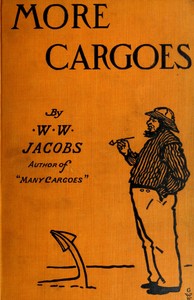
More cargoes 1897 — A Reader’s Guide can be approached with a clearer sense of reading commitment from its source measurements: 53,247 words, 3 hr 52 min estimated reading time, and 17 detected text sections.
The text analysis averages about 14.8 words per sentence, while the detected sections provide another way to judge how the source is divided.
Project Gutenberg metadata also associates the work with “Humorous stories, English,” connecting these edition facts with the source record’s subject description.
Explore this collection
These alternatives are selected using recorded categories and estimated reading time.
About 232 minutes
Sailors Ships
53,243 recorded words. 0 minutes difference from this book's estimate.
View Gutenberg source #21931About 245 minutes
Sailors Ships
56,338 recorded words. 13 minutes difference from this book's estimate.
View Gutenberg source #1698About 247 minutes
Sailors Ships
56,644 recorded words. 15 minutes difference from this book's estimate.
View Gutenberg source #1652Search stored excerpts and compare books → Choose by your preferences →
Choices use stored catalog measurements. Estimates vary with reading speed. A shared category is a catalog label, not a claim that two books have the same argument or literary quality.
Search reads excerpt text stored with this catalog and links to its associated Gutenberg record. The connection is stored in the site database; this tool does not recheck that every excerpt is word-for-word identical to that external record. Excerpt search does not cover every chapter and does not verify historical publication dates.
Catalog snapshot checked: 2026-09-26. Coverage: 95 public books, 95 available source excerpts.
Calculated from edition completeness, EPUB availability, text structure and catalogue metadata. Not a user rating.
Total of 100 points, scaled to a 2.5-5.0 range. Editions with an empty description or a missing EPUB file are not scored.
Public-domain source text
The source text is kept in the dedicated reader, separate from this catalogue record and its commentary.
In 'Smoked Skipper,' a fourteen-year-old boy posing as a seasoned captain hires a porter to carry his sea-chest to Wapping Old Stairs. The porter demands half a crown, but the boy claims he only has sixpence. The exchange—'Starboard, starboard your helium a bit'—shows Jacobs's ear for nautical jargon misapplied by a pretender. The humor lies in the boy's bravado and the adults' willingness to exploit or outwit him.
Jacobs renders speech phonetically to distinguish social class and personality. The porter says 'Fust v’y’ge, sir?' and 'two an’ sixpence,' while the waterman uses 'give us a hold o’ your box.' The boy, affecting authority, commands 'Starboard, starboard your helium a bit'—a mangled order that reveals his inexperience. In 'The Disbursement Sheet,' the narrator describes Simmons's bookkeeping as 'a series of dots and dashes' forming a code 'locked up somewhere in Simmons’s interior.' These verbal tics and narrative asides create a world where language itself is a tool for deception or self-aggrandizement.
Jacobs repeatedly places characters in positions of authority they cannot fill. The boy in 'Smoked Skipper' claims to know 'about the sea' but cannot negotiate a fare. The skipper in the same story, after losing freight money, is described as 'shook his head spiritlessly' and 'sinking on a locker.' His mate, George, offers dry irony: 'I’ve no doubt ’e’s all right. Don’t you worry about him.' The crew, having received a gift from the missing Hutchins, refuse to believe he stole the money: 'Nothing could ever make us think that.' The humor derives from the gap between the characters' self-image and their actual effectiveness.
Jacobs structures many scenes around a reversal where the apparent victim becomes complicit. In 'Smoked Skipper,' the boy fetches a policeman to threaten the porter, but the porter's extortion is merely replaced by the waterman's higher fare. The crew's loyalty to Hutchins—'He was too good'—is undercut by their willingness to keep the money. The skipper, trying to recover the loss, ends up bargaining: 'eighteen, we’ll call it, because I’m goin’ to have five of it back.' The cook's exit line—'Nothing could ever make us think that, would it, mates?'—shows a collective decision to ignore evidence. Jacobs suggests that in this world, everyone bends rules to suit themselves.
Jacobs achieves comic effect through understatement and abrupt shifts. In 'The Disbursement Sheet,' the old owner's method of accounting—'raking the sum out of the heap'—is described as 'severely simple,' while the new owner discovers Simmons's coded books. The narrator reports that 'the books of the inimitable Simmons being overhauled, revealed the startling fact that they were kept by single entry.' The word 'inimitable' is ironic, as Simmons's system is a mess. Jacobs often ends scenes with a flat statement that undercuts the preceding drama: 'they turned away and prepared for the labours of the day.' This deadpan style lets the absurdity speak for itself.
Readers should attend to the way Jacobs uses dialogue to reveal character and advance plot. The stories reward attention to small details—a mispronounced command, a coded ledger, a bag of brace buttons. The humor is cumulative, built from repeated patterns of self-deception and mutual exploitation. These are not tales of adventure but of human folly, told with a light touch and a sharp eye for the absurdities of maritime life.
Reading More Cargoes reminded me of my grandfather’s logbook—not the entries, but the margins where he sketched little waves. Those old sailors’ pretensions felt utterly human. I had the same quiet ache flipping through The Sandman: His Sea Stories — Text and Context, where every boast hides a stumble. Both books felt less like stories, more like eavesdropping on weather-worn hearts.
Answer a few questions and save a private reflection on this device.