P
pigzippa47
Guest
- Thread Author
- #1
[td]
 [/td]
Dear Colleague,
This week, we’re looking at what it takes to build practical, scalable edge AI systems. We explore why memory is becoming a critical bottleneck for advanced models, what separates successful deployments from stalled pilots, and how new processors and development tools are reshaping the path to production. I hope you find the mix useful as you evaluate where edge AI is headed next.
On Thursday, November 5, we’ll present a webinar on Yole Group’s latest edge AI processor market forecast through 2031, split by device class and application, from always-on sensors to consumer devices, vehicles and robots. Yole Group will also present their latest teardowns of edge AI devices, showing which chips are used, how they are integrated at the board level and what they cost. In addition, they’ll assess the processors themselves, looking at NPU architecture, process node, memory and the real cost of on-device inference. Join us for a unique assessment of the competitive field, covering incumbent MCU and SoC suppliers as well as emerging entrants, and exploring which chip characteristics decide design wins. More info here.
[/td]
[td]
 [/td]
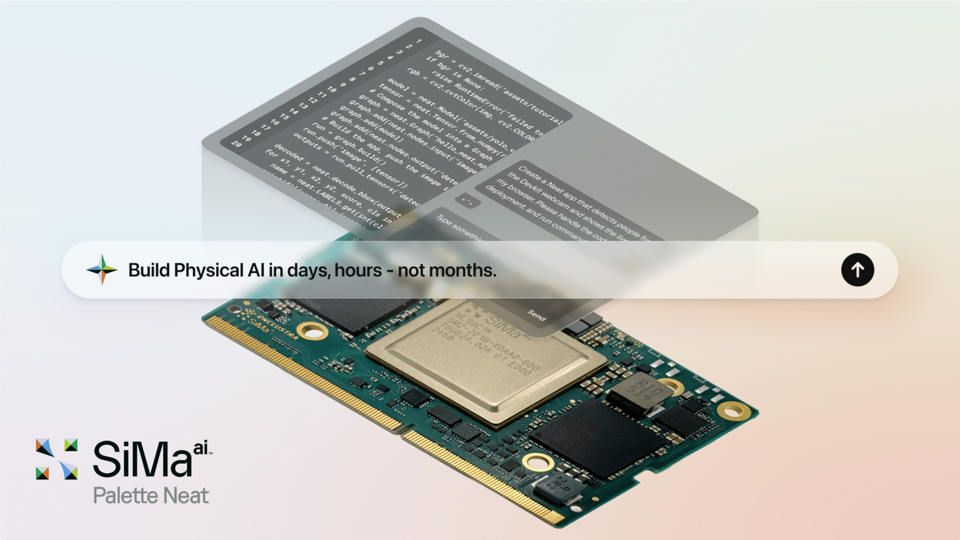
And, on Tuesday, November 17, we’ll present a webinar from SiMa.ai on development challenges facing physical AI engineers. SiMa.ai examines what engineers need from their development tools in order to move quickly from prototype to productized system: broad model support and compilation, fast testing and debugging, clean integration, and environments where AI coding agents work efficiently alongside engineers. They explain why development speed increasingly decides who reaches production, and what agentic development changes, using SiMa.ai’s Palette Neat development environment as a working example. They also share physical AI use cases with real impact, along with insights from real projects.
More info here.
There is still time to participate in the 2026 Computer Vision and Physical AI Developer Survey. Before the survey closes. We are seeking additional input from engineers building real systems with computer vision and other forms of sensor-based physical AI. If that describes your current or recent work, please take the survey soon. Your responses will contribute to a clearer picture of the technologies, practices and challenges shaping physical AI development. Qualified participants will receive access to an extensive set of survey results, along with an invitation to an exclusive webinar. During this live briefing, Alliance founder Jeff Bier will discuss early findings on topics such as VLMs, multimodal perception and other emerging physical AI trends.
Participate before the survey closes.
There is also still time to submit a presentation proposal for the 2027 Embedded Vision Summit. We’re looking for practical, technically substantive presentations that will help product creators address real-world challenges in computer vision and physical AI. Presenting is an excellent opportunity to share what you’ve learned, engage with an informed audience and connect with technical and business professionals tackling similar problems. Proposals will be considered until the agenda is full, so submit your idea soon for the best chance of being selected.
Learn More and Submit Your Proposal
Without further ado, let’s get to the content.
Erik Peters
Director of Ecosystem and Community Engagement, Edge AI and Vision Alliance
[/td]
[td]
 [/td]
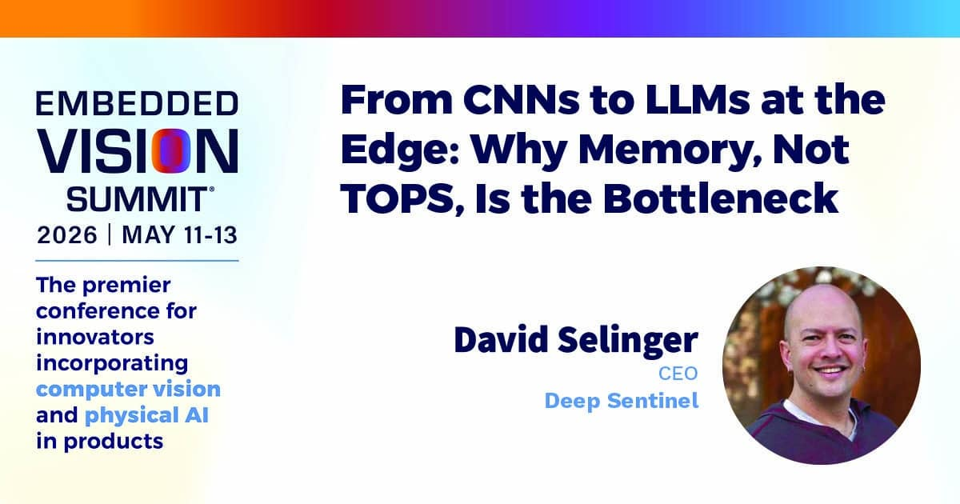
From CNNs to LLMs at the Edge: Why Memory, Not TOPS, Is the Bottleneck
Many teams are trying to move LLM-class intelligence onto edge cameras and sensors so video can be understood—and acted on—in real time. In this talk, David Selinger, CEO at Deep Sentinel, explains why this is hard by contrasting the compute and memory behavior of CNNs versus LLMs/VLMs. CNNs exploit locality, weight sharing and predictable memory reuse, so performance scales roughly linearly with image size and maps cleanly onto today’s NPUs. Transformers shift the bottleneck to quadratic attention (O[N²] compute and memory), high-bandwidth KV traffic and large, dense matmuls—turning memory pipelines, not TOPS, into the limiting factor for latency, power and cost. He then surveys practical paths forward: quantized small models, hybrid CNN-transformer pipelines, hardware-aware attention (e.g., FlashAttention and sparsity) and constrained task-specific models that reduce sequence length or operate in compressed domains. He closes with survey results on real-world use cases, chipset readiness and deployment pain points.
[/td]
[td]
 [/td]
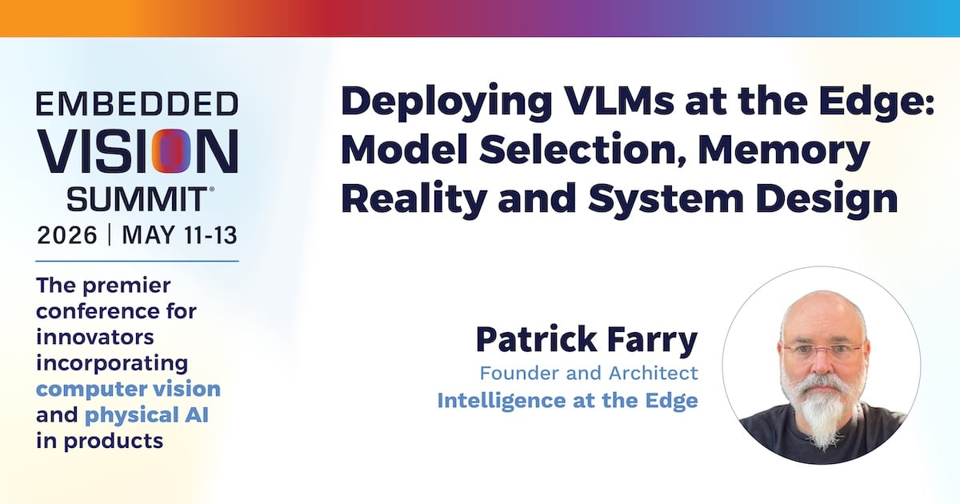
Deploying VLMs at the Edge: Model Selection, Memory Reality and System Design
Vision-language models (VLMs) enable “world understanding” tasks—natural language queries, zero-shot reasoning and richer scene context—that go beyond traditional CNN pipelines. But bringing VLMs to the edge is primarily a systems problem: selecting a model you can govern (license and data provenance), adapting it efficiently (prompting, quantization, LoRA-style fine-tuning, preference optimization) and fitting it into real device constraints where bandwidth and memory—not TOPS—determine feasibility. In this talk, Patrick Farry, Founder and Architect at Intelligence at the Edge, frames VLM deployment as an accuracy-latency-cost trade-off, then provides a practical decision framework for matching VLM architectures (vision encoder + projector + language model) to edge hardware. Viewers will leave with a selection matrix for NPUs vs. GPUs vs. hybrid pipelines, plus concrete rules of thumb for memory budgeting and throughput bottlenecks in real deployments.
[/td]
[td]
 [/td]
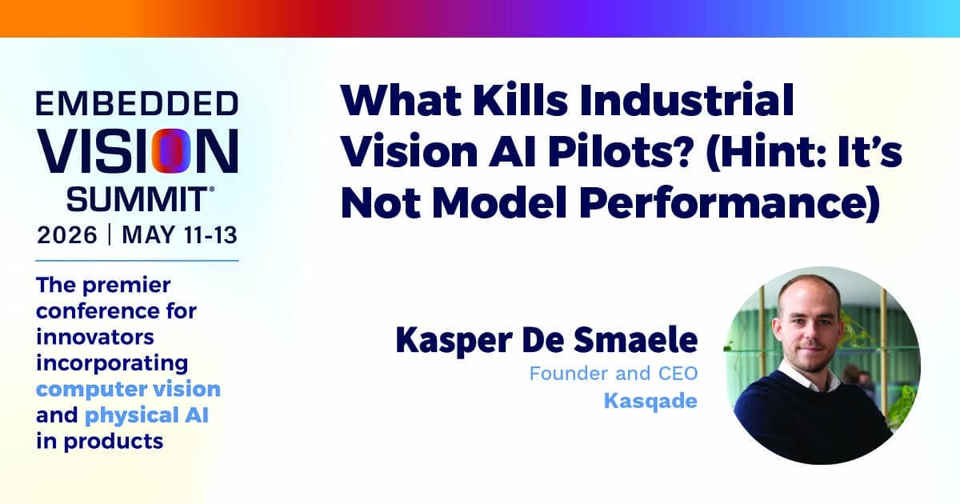
What Kills Industrial Vision AI Pilots? (Hint: It’s Not Model Performance)
An industrial vision AI pilot gets launched. Expectations are high. But something goes wrong. Why? Kasper De Smaele, Founder and CEO at Kasqade, shares lessons learned from implementing vision AI for the largest industrial companies in the world, in applications ranging from in-line quality control to microscope automation to robotics. He presents a practical view on why long time-to-value and a disconnect between the lab and the real world continue to kill these projects, as well as the patterns of those that succeeded. The focus is on real-world case studies from the biggest retailers, pharmaceutical companies, manufacturing companies and semiconductor companies worldwide, where he personally ran the projects from start to finish.
[/td]
[td]
 [/td]
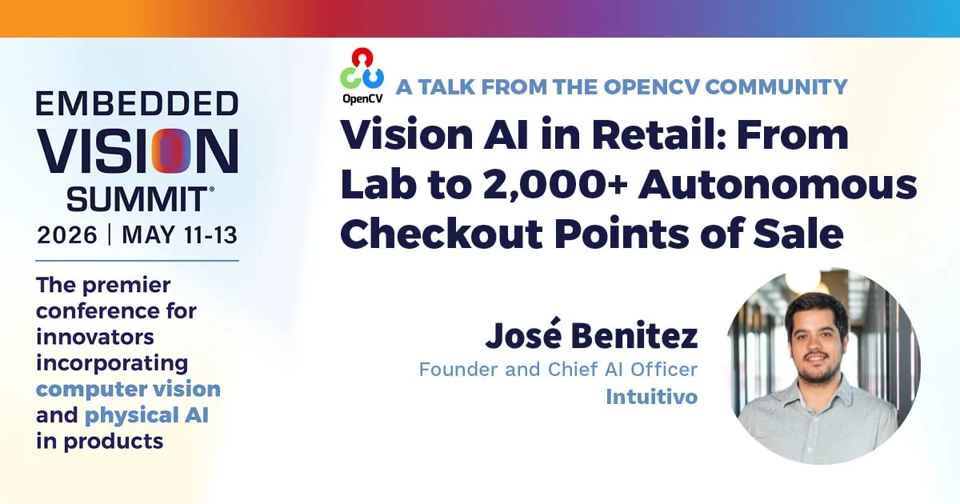
Vision AI in Retail: From Lab to 2,000+ Autonomous Checkout Points of Sale
Most vision AI systems that work in the lab fail when deployed across hundreds of real-world locations. Intuitivo operates 2,000+ autonomous points of purchase across enterprise locations, including Tesla, Microsoft, Walmart and Bank of America facilities, processing over 50 million images daily with a camera-only approach and no high-cost sensors. In this talk José Benitez, Founder and Chief AI Officer at Intuitivo, shares the engineering journey behind HERMES (Hierarchical Encoding and Reasoning Model for Event-Based Shopcarts), the end-to-end vision model that replaced our modular inference pipeline (object detection, tracking, heuristics) with a single trainable stage that fuses multi-camera video into transaction understanding.
[/td]
Maximize RISC-V Performance with Custom Design
– Andes Technology Event: October 7, 10:00 am PDT, Silicon Valley, CA
See AI on the Edge in Action
– Boston AI Event: October 7, 4:00 pm EDT, Waltham, MA
How Multimodal Sensing Enables Physical AI: Combining Intelligent Imaging and mmWave Radar
– D3 Embedded Webinar: October 8, 9:00 am PDT
Robotics AI in Practice: Build an End-to-End Developer Pipeline
– Intel Webinar: October 22, 10:00 am PDT
Edge AI Silicon: Market Forecasts, System Tear-Downs and Chip Analyses
– Yole Group Webinar: November 5, 9:00 am PDT
From Demo to Product: What It Really Takes to Ship Physical AI Applications
– SiMa.ai Group Webinar: November 17, 9:00 am PDT
Embedded Vision Summit: February 2-4, 2027, San Francisco, California
[/td]
Ambarella has launched X7, its first standalone AI accelerator, bringing CVflow processing to Arm and x86 systems through PCIe or USB, with operation at 2–5 watts in current customer designs, and has partnered with Ultralytics to bring YOLO models to CVflow-powered devices, simplifying deployment of real-time vision applications in smart cameras, robotics, automotive and industrial systems
NVIDIA has released Isaac ROS 5.0, adding AI-assisted robotics development workflows, updated perception libraries and ROS Lyrical support, with deployment across Jetson platforms from Orin Nano to Thor
Lattice has introduced Lattice Prompt, connecting AI coding assistants to its Radiant tools through Model Context Protocol to enable natural-language control of FPGA design, simulation, implementation and timing analysis
Synaptics has brought tactile sensing and Astra edge AI processing to NVIDIA Isaac Sim and Holoscan, helping developers simulate touch and combine tactile, vision and motion data for more precise robotic gripping and manipulation
MIPI Alliance has formed a Kinematics Working Group to develop a standard format for raw sensor data transported over CSI-2, initially focusing on radar and subsequently exploring lidar and other sensing technologies
More News
[/td]
[td]
 [/td]
Expedera Origin Evolution NPU IP (Best Edge AI Processor IP)
Expedera’s Origin Evolution NPU IP has been awarded the 2026 Edge AI and Vision Product of the Year Award in the Edge AI Processors IP category. Origin Evolution is a unique IP, specifically designed for the evolving needs of LLMs and VLMs at the edge while maintaining full compatibility with popular legacy networks like CNNs and RNNs. It includes specific processing blocks (vector, feed forward, attention) which specifically address the unique processing requirements of today’s and tomorrow’s evolving networks. Coupled with the hardware is a co-designed TVM and Relax-based software stack that enables developers to work efficiently as they deploy their networks on the target hardware.
Supporting popular frameworks such as HuggingFace, Llama.cpp, PyTorch, Onnx,TensorFlow, TVM, and others, users can deploy their trained models as-is; no retraining or accuracy reductions are required. Origin Evolution NPUs offer deterministic performance, the smallest memory footprint, and are fully scalable. This makes them perfect for edge solutions with little or no DRAM bandwidth or high-performance applications such as autonomous driving. ASIL-B readiness-certified, Expedera offers the ideal solution for engineers looking for a single NPU architecture that easily runs LLM, CNN, RNN, and other network types while maintaining optimal processing performance, power, and area.
Please see here for more information on Expedera’s Origin Evolution NPU IP. The Edge AI and Vision Product of the Year Awards celebrate the innovation of the industry’s leading companies that are developing and enabling the next generation of edge AI and computer vision products. Winning a Product of the Year award recognizes a company’s leadership in edge AI and computer vision as evaluated by independent industry experts.
[/td]
The post Edge AI and Vision Insights: September 30, 2026 appeared first on Edge AI and Vision Alliance.