P
pigzippa47
Guest
- Thread Author
- #1
[td]
 [/td]
Dear Erik,
This issue looks at two of the key decisions that shape the success of an edge AI product: what data to train on and which processor to build around. Blue River Technology and Synetic explore ways to improve training-data coverage, while RetailNext and Superfocus.ai offer practical guidance on evaluating processors. We also highlight new development tools, sensing products and edge AI capabilities, along with ENERZAi’s award-winning audio and language AI software.
There is still time to participate in the 2026 Computer Vision and Physical AI Developer Survey. If you build systems that use computer vision or other forms of sensor-based physical AI, please share your experience. Your responses will help clarify the key trends and challenges shaping development. Qualified participants will receive access to an extensive set of survey results and an invitation to an exclusive webinar in which Alliance founder Jeff Bier will discuss early findings.
Participate in the survey.
[/td]
It’s not too late to submit a presentation proposal for the 2027 Embedded Vision Summit. We’re looking for practical, technically substantive talks that help product creators solve real problems in computer vision and physical AI. Share what you’ve learned and connect with engineers and business leaders working on similar challenges. Proposals will be considered until the agenda is full, so submit your idea soon.
Learn More and Submit Your Proposal
Erik Peters
Director of Ecosystem and Community Engagement, Edge AI and Vision Alliance
[/td]
[td]
 [/td]
Training Models Starts with Data: Collection, Curation and the Refinement Loop
Training strong models starts with building strong datasets. In this talk, Umabharathi Govindarajan, Senior Machine Learning Engineer at Blue River Technology, presents a practical, end-to-end view of how data strategy drives model quality, development speed and iteration at scale. She covers the core decisions in data collection—what to capture, how much is enough and which operating condition variables (lighting, viewpoints, environments, edge cases) most influence required volume. She then shares curation principles for high-leverage training sets: matching real deployment conditions; maintaining balance across classes and scenarios; and pruning data that is irrelevant or misleading. Next, she discusses task-specific labeling, including how Blue River handles ambiguity, reduces inconsistency and implements quality checks. Finally, she focuses on evaluation data and iteration: building representative holdout sets; segmenting performance to expose failure modes; and running a data-refinement loop where deployment feedback guides targeted new collection and updates. Viewers will leave with a repeatable framework for making data decisions that scale.
[/td]
[td]
 [/td]
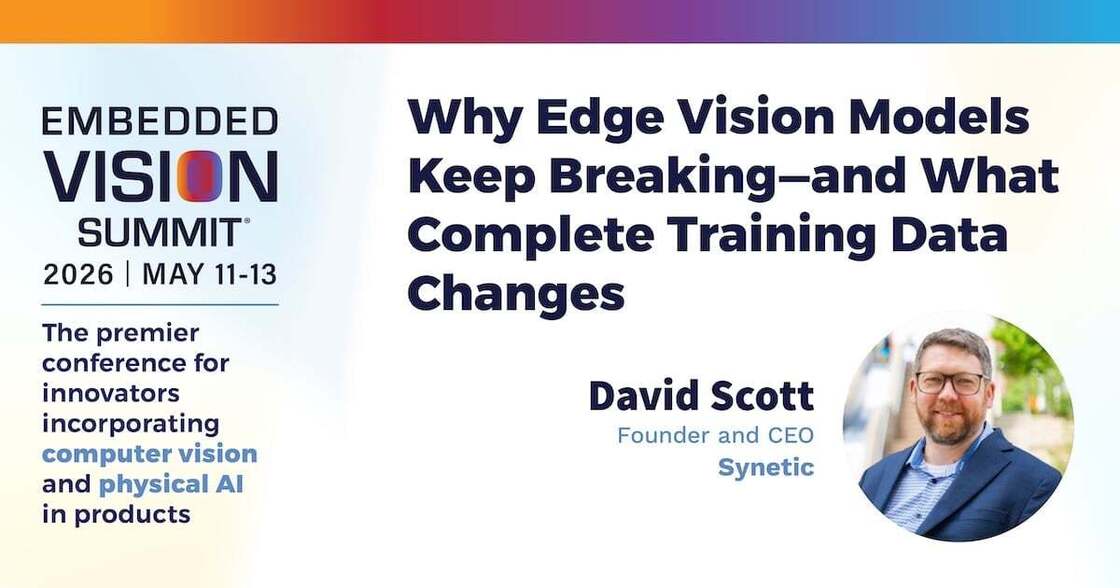
Why Edge Vision Models Keep Breaking—and What Complete Training Data Changes
Most edge vision deployments fail not because of model architecture, but because real-world training data is structurally incomplete. Sampled data can’t cover combinatorial edge cases, forcing perpetual retraining cycles that break embedded deployment, explainability requirements and silicon viability. In this session, David Scott, Founder and CEO at Synetic, explores what changes when training data is complete by design rather than sampled by accident. He presents peer-reviewed results showing synthetic approaches outperforming real-world data by 34%. He explains how physics-based synthetic generation provides deterministic control over geometry, lighting, occlusion, materials and sensors, and discusses implications for deployment on processors, ASICs and FPGAs. He also introduces a new class of models that work on first deployment and explains how complete training data enables regulatory compliance.
[/td]
[td]
 [/td]
Interview: Beyond TOPS—Evaluating and Selecting Processors for Edge AI and Vision
Join Mark Jamtgaard, Director of Technology at RetailNext, and Sally Ward-Foxton, Senior Reporter at EE Times, in an interview focused on how to evaluate and select processors for edge AI and computer vision products when the goal is to ship reliable systems—not win benchmarks. They dig into why model zoo numbers often fail to predict end-to-end performance and how data movement and image pipeline details (sensor interfaces, ISP quality, format conversion) become the real bottlenecks. They discuss how to judge software stack maturity—compilers, runtimes, operator coverage, profiling and debugging—and what “kill criteria” should prompt us to stop wasting engineering time early. They also discuss accuracy retention under quantization and optimization, determinism challenges and sustained performance under thermal constraints. And they explore fleet realities: observability, over-the-air (OTA) updates, remote debugging, life-cycle support and total cost of ownership. Viewers will leave with a concrete checklist of questions that de-risk processor selection decisions.
[/td]
[td]
 [/td]
Can Cheap Chips Run Multimodal AI? Lessons from Testing 17 SoCs
As small language and multimodal models improve, a practical question is emerging for product teams: have we hit a “good enough” quality threshold for embeddable AI, and what are the lowest-cost SoCs that can actually run these models end-to-end? In this talk Tushar Sheth, Co-Founder and CEO at Superfocus.ai, presents a comparative study of low-cost chips evaluated against consistent requirements, spanning small LLM inference, speech-to-text and text-to-speech and vision-language workloads. He shares performance results and explains why TOPS is often a poor predictor of real outcomes. He also highlights usability challenges arising from unsupported operators and brittle conversion/deployment toolchains. He explores where today’s NPUs are misaligned with transformer workloads and why quantized ~3B-class models often represent a practical ceiling. Viewers will leave with concrete selection criteria, a realistic view of current limitations and a road map of next steps—new silicon to watch, techniques for pushing toward bigger models and quality gains from fine-tuning.
[/td]
Arm Create
Arm Developer Event: October 19, 10:00 am–9:00 pm PT, San Jose, California
Robotics AI in Practice: Build an End-to-End Developer Pipeline
Intel Webinar: October 22, 10:00 am PT
Edge AI Silicon: Market Forecasts, System Tear-Downs and Chip Analyses
Yole Group Webinar: November 5, 9:00 am PT
From Demo to Product: What It Really Takes to Ship Physical AI Applications
SiMa.ai Webinar: November 17, 9:00 am PT
Embedded Vision Summit
February 2-4, 2027, San Francisco, California
[/td]
AMD has introduced Ross, an agentic AI assistant for embedded development, connecting natural-language interaction with AMD tools, technical knowledge and reusable workflows across hardware design, software, debugging and edge AI deployment
Chips&Media has announced lossless feature-map compression IP to reduce NPU memory traffic, with the algorithm and C-model ready and hardware implementation targeted for the first quarter of 2027
e-con Systems has launched NetraVis, an active-stereo 3D depth camera, combining depth sensing, a global-shutter RGB sensor, an inertial measurement unit and an onboard NPU for indoor robotic perception
SiMa.ai and Wobot.ai have partnered on reasoning-based video analytics, making Wobot’s solution available on Modalix PCIe cards and system-on-modules for on-site analysis in retail, food service, hospitality and manufacturing
Efinix has introduced the Sapphire RV64 SoC, a configurable 64-bit RISC-V processor core for FPGA designs, adding memory, caching and I/O capabilities for more demanding embedded and edge AI applications
More News
[/td]
[td]
 [/td]
Expedera Origin Evolution NPU IP (Best Edge AI Processor IP)
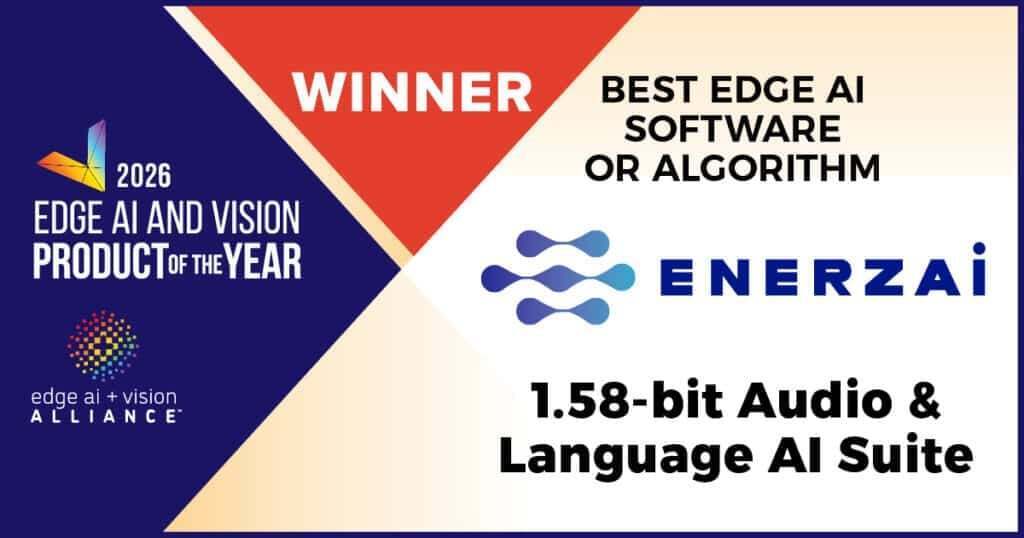
ENERZAi’s 1.58-bit Audio & Language AI Suite won the 2026 Edge AI and Vision Product of the Year Award in the Edge AI Software and Algorithms category. The suite is designed to bring audio and language capabilities directly to devices with limited memory and processing resources, reducing reliance on cloud inference.
It combines quantization to precisions as low as 1.58 bits with Optimium, ENERZAi’s proprietary inference technology, to support efficient execution of these models. Target applications include voice commands, translation, speech summarization, knowledge-based question answering and function calling. For product developers, the suite offers an approach to adding local audio and language features while addressing memory, power, latency and cloud operating costs.
Please see here for more information. The Edge AI and Vision Product of the Year Awards recognize innovation in products that enable or incorporate edge AI and computer vision, as evaluated by independent industry experts.
[/td]
The post Edge AI and Vision Insights: October 14, 2026 appeared first on Edge AI and Vision Alliance.