About 490 minutes
The Frozen Pirate — Text and Context
Pirate Stories
112,516 recorded words. 3 minutes difference from this book's estimate.
View Gutenberg source #22215
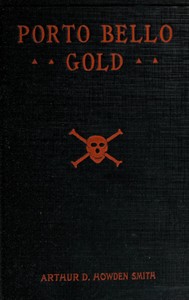
For Porto Bello gold — A Reader’s Guide, the stored edition analysis reports 113,208 words, 8 hr 13 min estimated reading time, and 11 detected text sections.
The text analysis averages about 14.1 words per sentence, while the detected sections provide another way to judge how the source is divided.
Project Gutenberg metadata also associates the work with “Sea stories,” connecting these edition facts with the source record’s subject description.
Explore this collection
These alternatives are selected using recorded categories and estimated reading time.
About 490 minutes
Pirate Stories
112,516 recorded words. 3 minutes difference from this book's estimate.
View Gutenberg source #22215About 481 minutes
Pirate Stories
110,498 recorded words. 12 minutes difference from this book's estimate.
View Gutenberg source #44875About 511 minutes
Pirate Stories
117,418 recorded words. 18 minutes difference from this book's estimate.
View Gutenberg source #1965Search stored excerpts and compare books → Choose by your preferences →
Choices use stored catalog measurements. Estimates vary with reading speed. A shared category is a catalog label, not a claim that two books have the same argument or literary quality.
Search reads excerpt text stored with this catalog and links to its associated Gutenberg record. The connection is stored in the site database; this tool does not recheck that every excerpt is word-for-word identical to that external record. Excerpt search does not cover every chapter and does not verify historical publication dates.
Catalog snapshot checked: 2026-09-26. Coverage: 95 public books, 95 available source excerpts.
Calculated from edition completeness, EPUB availability, text structure and catalogue metadata. Not a user rating.
Total of 100 points, scaled to a 2.5-5.0 range. Editions with an empty description or a missing EPUB file are not scored.
Public-domain source text
The source text is kept in the dedicated reader, separate from this catalogue record and its commentary.
The novel opens not on the Admiral Benbow but in a counting-room on the New York waterfront, where Robert Ormerod, the narrator, learns of a pirate ship off the Hook from a boy named Darby. The scene immediately establishes a contrast between mercantile order—ledgers, fur-trade talk with Peter Corlaer—and the lawless sea. Smith’s prose leans into physical detail: Peter’s “huge belly waggling before him beneath his buckskin hunting-shirt” and Darby’s “brogue that thickened whenever he grew excited.” This is a world where the domestic and the violent coexist, and where the legacy of Robert Louis Stevenson’s characters is reimagined through a new narrator’s eyes.
The dedication poem, addressed to “Tusitala” (Stevenson’s Samoan name), openly acknowledges the novel as a “wretched, miswrought tale” that dares to continue the story of “John Silver’s with us still.” This self-deprecating frame is not mere modesty; it signals Smith’s intention to work within Stevenson’s shadow while expanding the world. The epigraph’s reference to “all the raffish, ruffian crew / That you and young Jim Hawkins knew” positions Porto Bello Gold as a direct prequel, explaining how the treasure map came to be. Smith borrows Stevenson’s narrative voice—first-person, retrospective, laced with nautical jargon—but adds his own flourishes, such as the detailed description of the pirate ship’s damage: “her rigging in tatters, her spars split and wounded, her fo’csle and foredeck one red litter.” The result is a hybrid: faithful in spirit, yet distinct in its focus on the adult world of commerce and conspiracy.
The excerpt of the battle aboard the Spanish treasure ship is the novel’s set piece, rendered with cinematic precision. Smith lingers on physical details: the pirates “stripped to the waist, their lowering faces smutted with powder-stains, their hairy chests barred with tattooing.” The narrator’s great-uncle Murray leaps “all of ten feet, sword in hand,” and dispatches opponents with “the cool precision of a fencing-master.” But the scene also undercuts heroic violence with grim reality: the pirates kill three surrendered men before they can be stopped. The presence of priests and nuns among the Spanish passengers adds a moral dimension absent from Treasure Island—here, the stakes include not just gold but human lives caught between empires. Smith uses the chaos to introduce a parley, hinting at political intrigue beneath the piracy.
The opening chapter establishes a colonial New York where bonded servants like Darby (“a raw, bog-trotting bit of a gossoon”) and fur-traders like Peter Corlaer (a Dutchman “come down-river from the Iroquois country”) represent the diverse, often coerced labor that underpins the Atlantic economy. The narrator’s father’s “secret” (the treasure map) is a family matter, but it is also a product of imperial plunder. The novel’s title—Porto Bello Gold—references the Panamanian port where Spanish treasure was loaded, a real historical site of piracy. Smith’s characters move between counting-house and quarterdeck, suggesting that the line between merchant and pirate is thin. The presence of O’Donnell, an Irish colonel in Spanish service, further complicates loyalties, hinting at the Jacobite and Catholic networks that operated across empires.
Readers familiar with Treasure Island will find Porto Bello Gold a curious companion: it fills gaps in the backstory but also introduces new characters and moral ambiguities. Pay attention to how Smith handles the transition from young Robert’s perspective to the adult world of Long John Silver—the novel’s tone shifts from adventure to something darker, where treasure comes at a human cost. The text rewards attention to its historical details, from shipboard hierarchy to the politics of the Spanish Main.
There’s a particular ache in Porto Bello Gold—young Ormerod watching Silver’s charm curdle into something colder, knowing the map will outlast the friendship. I felt that same quiet disappointment reading about the Admiral’s later crew in The Devil’s Admiral — Edition Insights. Some betrayals start as boyish hope. I still think about that first chapter sometimes.
Use these questions to collect your thoughts before moving on.