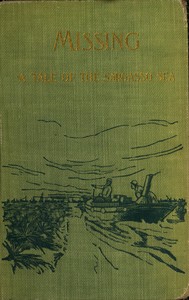
"In Sargasso." Missing, a romance — Reading Notes
Edition facts
"In Sargasso." Missing, a romance — Reading Notes can be approached with a clearer sense of reading commitment from its source measurements: 56,087 words, 4 hr 4 min estimated reading time, and 35 detected text sections.
The text analysis averages about 20.7 words per sentence, while the detected sections provide another way to judge how the source is divided.
Project Gutenberg metadata also associates the work with “Sea stories,” connecting these edition facts with the source record’s subject description.
Calculated from edition completeness, EPUB availability, text structure and catalogue metadata. Not a user rating.
How this score is calculated
- Description quality20 pts
- Title & short description10 pts
- Source metadata20 pts
- Text length15 pts
- Chapters / structure15 pts
- EPUB file integrity20 pts
Total of 100 points, scaled to a 2.5-5.0 range. Editions with an empty description or a missing EPUB file are not scored.
Read the Text
A KNIGHT-ERRANT OF THE SEA.
My name, with that of my crew of forty men, has been posted for two years at Lloyds in New York and London, followed by the single word “Missing.” This statement is still true of the two score of good men who sailed with me in the steamer Caribas, but I have returned to New York alive.
I am an American, was born and raised in Brooklyn, and served my apprenticeship before the mast on the “Black Ball” line between New York and Liverpool.
I then entered the employment of Cameron & Co., at the age of 23, as second mate on one of the Australian ships, and made four voyages ’round the Horn to Melbourne. As we sailed on our return journey the last time I was made first mate, and, although only 27 years of age, an accident to the captain during the first week gave me command of the ship for the three months that succeeded.
On my arrival at New York I was offered a position as captain of a tramp steamer sent out from Plymouth by Triplett & Jones. That firm is one of the largest owners of vessels for charter in Great Britain. The little iron steamship was already in New York, and I went down to the Erie Basin to look her over. The Caribas, named after the Marquis of that name, was a trim craft. Her engines were of the newest pattern. She had no accommodations for carrying passengers, but her general fittings and equipment were excellent. The cabin and the captain’s quarters were finished in mahogany; the forecastle was in hardwood, and very comfortable for the men. Although I had previously had a contempt for a tramp steamer and thought the command of such a craft unworthy of a deep-water sailor, I decided to accept this position, and to follow for a few years the wandering life it entailed.
There was some glamour attaching to the position, because, unlike the master of a transatlantic steamship, whose route is over the same course week after week, the commander of an ocean tramp visits all parts of the world. Entering port to deliver his cargo of goods to a consignee, he knows not whether a cable order awaiting him there will take him to the North Atlantic or the Indian Ocean, to Halifax or to Singapore. He must accept his duty in any climate; and the likelihood is that in the end his friends and employers will be watching the register at Lloyds, just as were mine through two long and lingering years.
The commander of a tramp steamer is a commercial knight-errant of the sea--a homeless wanderer, cut off from all ties of blood and affection, and devoted to the remorseless accumulation of gain for people personally unknown to him. His pay is always small, and the only opportunity he has of increasing it is by an occasional passenger from port to port, for whom he can surrender his stateroom and enjoy instead a sofa in the cabin.
Romantic as is his life, I never knew the commander of an ocean tramp who excelled at handling the English language. He may know how to box the compass, to calculate the latitude and longitude from the midday sun, to follow out the chart, or to work down a lee shore with the lead, but when it comes to writing, he usually lards his text with so many words only known to sailor men that the general reader is mystified and bored. While, modestly, I might claim a somewhat varied experience in the forecastle and the cabin, this is my first attempt at wielding a pen, and I shall rely very much upon the trusty blue pencil of the editor to render what I shall say creditable to me.
We sailed from Harbeck’s Stores, New York harbor, on a fair June day, for the Azores, intending to make our first call at Horta, and then to touch at Ponte Delgada, whence we would proceed to Lisbon for orders.
At the last hour I had accepted a passenger in the person of Arthur Gray. He claimed to be an artist, and certainly exhibited evidences of his profession in the portfolio and drawing pads that made part of his luggage. He had with him one of the new Secor launches, propelled by direct explosion against the water astern. It was built with more shear than an ordinary craft of the kind, so that, as he maintained, it would be possible to navigate the ocean in calm weather.
Three days from New York, at Gray’s urgent solicitation, I altered the course of the Caribas. After reaching longitude 40 I steered to the southeast and held that direction until the morning of the fifth day, when we began to sight many derelicts. My guest understood the purport of this quite as well as I did. He knew we were nearing the Sargasso Sea, that great assemblage of seaweed and floating hulks that for centuries has been accumulating in the eternal calm of the mid-Atlantic.
The gazetteers define the geographical limits of the Sargasso Sea as included between 22 degrees and 28 degrees north latitude and 25 degrees and 60 degrees longitude west of Greenwich. In area, therefore, it equals about 200,000 square miles, only slightly less than that occupied by the State of Texas. Its position varies somewhat from year to year, navigators maintaining that the floating continent, under the influence of a deflected African current, is brought several hundred miles nearer to the Azores some years than others.
I am not prepared to deny this, though I believe the extent of the change is exaggerated.
Being the navigating officer, as well as captain of the Caribas, I felt considerable responsibility in taking my vessel into this uncharted part of the Atlantic. The official Admiralty chart, as well as that supplied by our Navy Department, indicated open water in all that vast stretch between the Azores and Bermuda. But already large masses of floating sod, composed of matted and interlaced trees and seaweed, were within sight. I remembered the story of the ancient Argonauts, who sailed in the first tramp voyage to Colchis, and who encountered islands that “clapped together with the swell of the tide!” In the Sargasso Sea I found a veritable realization of that statement in the watery lanes that separated islands of seaweed. They were constantly varying in width. I was, naturally, very wary of penetrating any of these narrow sounds, for fear that the adjacent islands might close together and cut off my retreat.
A cast of the lead showed great depth. To anchor was impossible. I admit, however, that the thoughts of abandoned wealth to be found aboard the thousand floating craft of the Sargasso Sea appealed to my cupidity so strongly that, after a day’s deliberation, I made fast to a great, rolling hulk that had once been a full-rigged ship. She was badly water-logged and had listed to an angle of 25 degrees.
The sun rose above the eastern horizon with great splendor on the following morning. The sky was clear and almost golden-hued. I was called on deck by the first mate because of the report from a man at the masthead, who had been sent aloft with a good glass to make a survey of the surrounding ocean. The mate first brought to my attention a wonderful mirage that appeared just above the horizon. I had never before observed a mirage in the eastern sky, and had supposed that it was only possible for the setting sun to produce it. But on this occasion all my experience was swept aside, and we saw plainly in the sky an assemblage of vessels, of all sizes and conditions, each separated by a narrow strip of green sod, so arranged that they might not crash together and destroy each other. The masts were still standing on some, but in most cases these were utterly gone. I cannot describe at this time the thrill of curiosity with which I scrutinized the strange discovery. There was a semblance of order regarding the arrangement of the ships that promptly suggested to my active imagination the presence of a directing human intelligence. But I said nothing to the mate on that subject.
We were joined at the bow by my passenger, Arthur Gray, who was in an almost uncontrollable condition of enthusiasm. He had been talking with the man from the masthead, and added to our information the startling declaration of the lookout that he had descried moving objects in the City of Ships!
If I had been lukewarm before; if I had hesitated regarding the exploration of the mysterious region, my mind was brought to an abrupt and decisive conclusion by this statement. I ran up the rattlings to the masthead and was greatly astonished at what I beheld. About thirty miles to the southeast was clearly to be seen the same congregation of vessels reflected in the sky and already described by the man who had been aloft.
Then and there I resolved to accept the proposition of Arthur Gray to enter his launch and go on a voyage of exploration.
Committing the care of the Caribas to my first mate and taking my quadrant, one of the ship’s chronometers and several days’ provisions, I prepared to enter the launch as soon as it was ready.
A derrick was rigged from the foremast, and the stanch little craft was soon hoisted over the ship’s side with the aid of a steam windlass. Meanwhile, all the oil tanks in the launch had been filled, and, adding a water cask, we were soon ready.
Fully expecting to return within forty-eight hours, I merely gave the first officer general directions regarding the care of the ship. I told him to keep the men employed with the tar bucket and the holy stone. On leaving I saluted the first mate.
The second mate stood at the ladder and touched his cap as I descended. He evidently had a premonition of coming trouble, and was so far guilty of a breach of discipline as to suggest that he be allowed to accompany me upon my hazardous journey. I replied with a frown and a shake of the head.
Without any suggestion from the owner of the launch, I took my seat at the tiller, while Gray looked after the engine. Despite the rigid discipline maintained aboard the Caribas, the entire ship’s company, except those actually engaged in scrubbing the deck, assembled at the bulwarks to watch our departure. I confess that I was rather pleased than annoyed at this.
It touched my vanity, as I suppose it would have awakened that feeling in any man.
We got under headway about 9 o’clock and made for the first broad canal we discovered. While at the masthead I had attempted to follow this channel with my glass, just as I might have traced the sinuous windings of a sluggish stream through a grassy meadow; but I had not been able to outline its course beyond a few miles, because of the height of the brushwood, covered with its parasitic growth of plants. We steamed along gayly under full headway for about an hour, doing about eight miles, I should say, because of our heavy load, and although the channel we navigated varied greatly in width at places, it was broad enough at all points to have admitted the Caribas. The average width of the passage was about that of the Grand Canal at Venice, and though its convolutions were more numerous, we had no trouble in following the main channel.
As we penetrated farther and farther into this great mass of floating herbage, I was particularly struck with the strange mental effect produced upon me by the rise and fall of the ocean swell underneath the overlying mass. For the first time in my life I felt a sense of dizziness and seasickness. To the eye it was much the same as if in the midst of a far-reaching prairie one should find the land heaving and sinking in long undulations.
All this time I had kept close to my right hand a repeating rifle; but under the pretext of wishing to shoot some wild fowl, my companion gained possession of it and moved off to the bow of the boat. I thought nothing of this act for some time, but I observed that Gray always left the gun forward when he came amidships to attend to the engine.
When, at the end of three hours, we had come within plain sight of the great cluster of swaying hulks, and had reached a point where many small canals radiated from a central pool, my companion, the artist, promptly indicated the channel that I was to take and showed a familiarity with the landmarks that actually startled me. He would say: “Steer for that redwood tree on the port bow; bear ’round by that logwood trunk; keep wide out, and avoid the wire grass on the right just ahead; take care here, there’s a sunken tree; put the helm hard down or we won’t round this corner,” and many other expressions indicating previous knowledge of the place.
I was on the point of asking him several times whether he knew or simply divined the obstructions, but I was so busy watching his movements, which now had aroused my suspicions, that I did not scrutinize the prospect ahead. For that reason we had approached within a short distance of the community of floating wrecks before I gave it careful survey.
Unslinging my glass, I focused it upon the first large vessel, and was startled to find objects moving about its decks. Uttering an exclamation of astonishment, I hailed my companion for an explanation. He burst into a hysterical laugh, but made no answer.
“What are they?” I asked. “Brownies or living people?”
“They are my countrymen!” was his reply, with an arrogance that was offensive to me.
My first thought was to reach for my Winchester and compel him to return to the Caribas; but the gun was in his possession.
A moment later the engine quit working--evidently due to some false adjustment by Gray. I also discovered that the oars I had placed in the boat for use in case of accident had been dropped overboard, unobserved by me.
Though I had been brought up on the sea, knew no other life, and had passed through all sorts of dangers of calm and storm, I became imbued with an indescribable dread of my companion and of the strange people on the floating derelicts.
Carried by a current that I had not before observed, we were soon within hailing distance of a large hulk, and my companion gave a signal that was clearly recognized by the people on board.
Low as we were in the water, seated in the launch, I am sure that fully 500 vessels of all sizes, descriptions and conditions were in sight. Some of them were moss-grown. Others were covered with coats of barnacles inches in thickness. Many were bright and new as the day on which they left the ways and took their first plunge into the briny deep.
As we slowly drifted onward we were hailed from every ship we passed. The language was a weird and curious one, apparently a compound of all the modern tongues. All known languages of the world were represented. Though my early education had been indifferent, extensive travel had made me more or less familiar with Spanish, French, Italian, Portuguese, Norwegian, Russian, German, Greek, Danish and, I may say, several dialects of some of these languages.
Therefore I could follow the trend of the conversation between my companion and the Sargassons.
Their speech chiefly concerned me. Little by little I became cognizant of the fact that I had been lured away from my ship and into the hands of this strange people by this pretended artist emissary of the Sargassons. What the purpose of this kidnapping was did not at once appear. I could not comprehend of what possible service I could be to this community. The few valuables that I carried about my person, such as the Winchester gun, my watch and diamond pin, could have little value in their hands, because they had no occasions on which to display articles of jewelry. I soon discovered that my companion, the supposed artist, was well known throughout the community. He was hailed in a dozen different tongues from as many different vessels, and always in a respectful and familiar tone.
During all this time I had remained motionless at the stern of the launch, deliberating upon some plan by which I could get rid of my companion, and regain possession of the little craft, in which, by some miraculous means, I hoped to be able to return to my ship. The break-down of the machinery had, however, cut off that possibility. Capture seemed inevitable, although I fully realized that, had I possession of my Winchester gun, with the belt full of cartridges that I still retained about my waist, I could hold at bay the entire Sargasson nation. I reasoned at the time, and, as I afterwards ascertained, correctly, that powder was scarce among the Sargassons.
My first impulse had been to shoot my treacherous companion with the revolver I carried in my hip pocket. But I discovered that it did not contain a single loaded cartridge, and the recognition of that fact by my guard, who, from the bow of the boat, constantly kept me under cover with my own gun, increased his confidence and caused him to jeer at me. I therefore made the best of a bad situation and surrendered. I took one precaution, however, that was to secretly loosen the belt of cartridges from my waist and drop it into the sea.
A line made of twisted sea grass was finally thrown to Gray from one of the largest vessels, and we were soon drawn alongside. This hulk stood fully twenty-five feet out of water, and was imbedded in a thoroughly compact mass of floating verdure. As the boat was made fast to a narrow strip of sod and interlaced twigs that separated the vessel from the open water, my companion sprang out lightly upon a tree trunk, and, addressing me familiarly, said:
“We land here, captain.”
There was nothing for me to do but to comply with his suggestion, and, making my way forward to the landing place, I sprang out of the boat as gayly as I could be expected to do under the circumstances. No sooner had my feet touched the mass of floating sod than I was made acquainted with a new and startling horror. I found the mass of tangled herbage alive with crawling insects, upon which large serpents, that abounded in great numbers, fed.
The trees that form a large portion of this garbage heap of the Atlantic are brought down from the upper Amazon during the tremendous freshets that prevail under the equator and are carried through from the Caribbean Sea and the gulf to the midocean swirl, where they reach their final haven. Their track throughout is along the current of the Gulf Stream, whose warm waters protect the animal life that happens to be upon the trees at the time they are carried out to sea. I afterwards learned that at one time marmosets from Brazil existed in considerable numbers in Sargasso, but the large serpents finally had exterminated them. I always had had a horror of snakes and lizards, and I therefore made haste to cross the quivering bog-holes leading directly to the water below.
My captor followed, encouraging me and directing me where to step in order to avoid mishaps. For the reason I have named, I gladly sprang up the ladder that had been constructed on the side of the ship as soon as I reached it.
At the ship’s side, as I emerged above it, stood a man of unusually strange appearance. As I soon came to know him, he was the Kantoon of the particular communal family having its habitation on that ship. He was 60 years of age, with a grizzly gray beard, clipped or singed to an almost uniform length of three inches, that covered his face. His dress was made of what I afterwards discovered to be sun-tanned porpoise skin. His cap was of dark-brown leather, that had apparently done duty as a cushion cover. But I experienced another surprise when, on stepping over the gunwale to the deck, I found that the commander of the craft stood up to his knees in a tub of water!
The narrative voice of Captain Austin Clark is established immediately as that of a man who has been officially declared missing, his name posted at Lloyds for two years. The opening chapter, titled "A Knight-Errant of the Sea," signals a self-conscious, almost literary framing of his adventures. The preface, written by Julius Chambers, presents the Sargasso Sea as a "wonder-shop" of lost treasures and secrets, a tone that colors the entire account. Clark's story is not merely a survival tale but a detailed report on the customs and politics of a hidden society, complete with specific incidents like the Chin-Goone revolt and the threat of a Napoleonic expedition.
The Sargasson World: A Society of Castaways
The excerpts depict a fully realized society with its own laws, hierarchies, and rituals. The Sargassons are described as a "nation of castaways," living on a floating continent of seaweed and wrecked ships. Their governance includes Kantoons (chiefs) and a High Priest, and justice is harsh and public: the young rebel Chin-Goone, after scuttling 100 ships to prevent a Napoleonic expedition, submits to being "triced up and cast into the sea" on the anniversary of his act. The punishment for a treacherous woman involves tattooing age lines and bleaching her hair, a method the narrator finds appalling. These details, drawn from chapters on "Sargasson Manners and Customs" and the Chin-Goone revolt, show a culture that is both alien and internally consistent.
Suspense and the Threat of Violence
Clark repeatedly emphasizes the tension and danger of his situation. The threat of attack from rival crews, the abduction of Fidette, and the constant vigilance required are central to the narrative. He draws a parallel to his own naval experience during the Virginius troubles, recalling a night of silence and suspense aboard the USS Wabash, and notes that "the memory of that moonlight night... was renewed every night on board the Happy Shark." This comparison grounds the fantastical setting in a recognizable reality of naval discipline and fear. The chapters on "The Agony of Suspense" and "Nights of Sleepless Anxiety" suggest that the emotional core of the story lies in the protagonist's psychological state as much as in external events.
Objects of Power: The Papier-Mâché Oranges
A striking detail emerges in Chapter XVI: Fidette shows Clark a hanging basket containing "a dozen or more orange-like spheroids" that he initially mistakes for real fruit. They are actually "detonating bombs, manufactured in Wilmington, Del., and used upon the Fourth of July." This object—a piece of American industrial production repurposed in a remote seaweed sea—encapsulates the novel's fascination with the collision of worlds. The bombs are both a practical tool and a symbol of the outside world's intrusion into Sargasso. The narrator's recognition of them as familiar objects from his own culture highlights his dual role as observer and participant, and the potential for these items to alter the balance of power in the community.
The excerpts suggest that "In Sargasso" is less a straightforward adventure than a speculative ethnography, filtered through a narrator who is both captive and chronicler. Readers should attend to the tension between Clark's desire to escape and his growing involvement in Sargasson politics, as well as the novel's use of real-world objects and historical events to lend credibility to its fantastical setting. The romance with Fidette, hinted at in chapter titles, appears to be intertwined with the larger narrative of survival and cultural negotiation.
There’s something haunting about how Captain Clark’s loneliness among the Sargassons mirrors Marryat’s own restless solitude at sea. I think of that while turning these pages, remembering how a shared silence can feel more intimate than words. The old Life of Frederick Marryat — Inside the Classic rests nearby, dog-eared, like an old friend who understood this ache without ever saying so.
Mila Thomas
3 weeks agoEvelyn Moore
1 week agoGabriel Roberts
1 week agoGrace Rodriguez
2 weeks ago-
Alicia Hernandez - 1 month ago
In Sargasso Missing promised a haunting romance but delivered a tepid love story with a convoluted plot. The characters are one-dimensional, and the mystery is resolved in an unsatisfying way. The pacing is glacial, and the prose is overly flowery, bogging down the narrative. I struggled to finish this, and I wouldn't recommend it to anyone seeking a compelling tale. -
John Joel Ayala - 4 weeks ago
In Sargasso Missing offers a unique blend of romance and mystery. The setting is atmospheric, and the love story is touching. However, the plot sometimes moves slowly, and the supernatural elements feel a bit out of place. Still, the characterization is strong, and readers who enjoy gothic romances will likely appreciate this one. -
Tina Hodge - 3 weeks ago
In Sargasso Missing is a haunting and beautifully written romance set against the eerie backdrop of the Sargasso Sea. The mystery of the missing ship and the tragic love story entwine to create a gripping narrative. The author's descriptive prose evokes the vastness and loneliness of the ocean, making for an atmospheric read. The emotional depth and unexpected twists left me breathless. Highly recommended.
Before you leave, reflect on the book
Use these questions to collect your thoughts before moving on.

Carter Wright
1 month ago