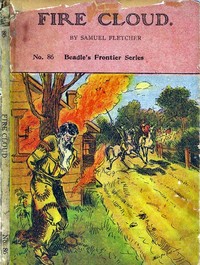
Fire Cloud; Or, The Mysterious Cave. A Story of Indians and Pirates. — Inside the Classic
Edition facts
The source record for Fire Cloud; Or, The Mysterious Cave. A Story of Indians and Pirates. — Inside the Classic measures this digital text at 30,963 words, 2 hr 15 min estimated reading time, and 3 detected text sections.
The text analysis averages about 22.8 words per sentence, while the detected sections provide another way to judge how the source is divided.
Project Gutenberg metadata also associates the work with “Indians of North America -- Fiction,” connecting these edition facts with the source record’s subject description.
Calculated from edition completeness, EPUB availability, text structure and catalogue metadata. Not a user rating.
How this score is calculated
- Description quality20 pts
- Title & short description10 pts
- Source metadata20 pts
- Text length15 pts
- Chapters / structure15 pts
- EPUB file integrity20 pts
Total of 100 points, scaled to a 2.5-5.0 range. Editions with an empty description or a missing EPUB file are not scored.
Read the Text
Whether or not, the story which we are about to relate is absolutely true in every particular, we are not prepared to say. All we know about it is, that old Ben Miller who told it to our uncle Zeph, believed it to be true, as did uncle Zeph himself. And from all we can learn, uncle Zeph was a man of good judgment, and one not easily imposed upon.
And uncle Zeph said that he had known old people in his younger days, who stated that they had actually seen the cave where many of the scenes which we are about to relate occurred, although of late years, no traces of any kind could be discovered in the locality where it is supposed to have been situated.
His opinion was, that as great rocks were continually rolling down the side of the mountain at the foot of which the entrance to the cave was, some one or more of these huge boulders had fallen into the opening and completely closed it up.
But that such a cave did exist, he was perfectly satisfied, and that it would in all probability be again discovered at some future day, by persons making excavations in the side of the mountain. And lucky he thought would be the man who should make the discovery, for unheard of treasures he had no doubt would be found stowed away in the chinks and crevices of the rocks.
So much by way of introduction; as we have no intention to describe the cave until the proper time comes, we shall leave that part of the subject for the present, while we introduce the reader to a few of the principal personages of our narrative.
At a distance of some fifteen or twenty miles from the City of New York, on the Hudson river in the shadow of the rocks known as the Palisades, something near two hundred years ago, lay a small vessel at anchor.
The vessel as we have said was small. Not more than fifty or sixty tons burden, and what would be considered a lumbering craft now a days with our improved knowledge of ship building, would at that time be called a very fast sailor.
This vessel was schooner rigged, and every thing about her deck trim and in good order.
On the forecastle sat two men, evidently sailors, belonging to the vessel.
We say sailors, but in saying so we do not mean to imply that they resembled your genuine old _salt_, but something between a sailor and a landsman. They could hardly be called land lubbers, for I doubt if a couple of old salts could have managed their little craft better than they, while they, when occasion required, could work on land as well as water.
In fact they belonged to the class known as river boatmen, though they had no hesitation to venturing out to sea on an emergency.
The elder of these men, who might have seen some fifty years or more, was a short, thick set man with dark complexion, and small grey eyes overshadowed by thick, shaggy brows as black as night.
His mouth was large when he chose to open it, but his lips were thin and generally compressed.
He looked at you from under his eyebrows like one looking at you from a place of concealment, and as if he was afraid he would be seen by you.
His name was David Rider, but was better known among his associates under the title of Old Ropes.
The other was a man of about twenty-five or thirty, and was a taller and much better-looking man, but without anything very marked in his countenance. His name was Jones Bradley.
"I tell you what, Joe," said his companion, "I don't like the captain's bringin' of this gal; there can't no good come of it, and it may bring us into trouble."
"Bring us into trouble! everything that's done out of the common track, accordin' to you's a goin' to bring us into trouble. I'd like to know how bringing a pretty girl among us, is goin' to git us into trouble?"
"A pretty face is well enough in its way," said Old Ropes, "but a pretty face won't save a man from the gallows, especially if that face is the face of an enemy."
"By the 'tarnal, Ropes, if I hadn't see you fight like the very devil when your blood was up, I should think you was giten' to be a coward. How in thunder is that little baby of a girl goin' to git us into trouble?"
"Let me tell you," said Ropes, "that one pretty gal, if she's so minded, can do you more harm than half a dozen stout men that you can meet and fight face to face, and if you want to know the harm that's goin' to come to us in this case I'll show you."
"The gal, you know's the only daughter of old Rosenthrall. Why the captain stole her away, I don't know. Out of revenge for some slight or insult or other, I s'pose. Now the old man, as you're aware, knows more about our business than is altogether safe for us. As I said before, the gal's his only daughter, and he'll raise Heaven and earth but he'll have her again, and when he finds who's got her, do you suppose there'll be any safety for us here? No! no! if I was in the captain's place, I'd either send her back again, or make her walk the plank, as he did, you know who, and so get rid of her at once."
"As for walking the plank," said the young man, laying his hand on his companion's shoulder, danger or no danger, the man who makes that girl walk the plank, shall walk after, though it should be Captain Flint himself, or my name is not Jones Bradley."
"You talk like a boy that had fallen dead in love," said the other; "but anyhow, I don't like the captain's bringing the young woman among us, and so I mean to tell him the first chance I have."
"Well, now's your time," said Bradley, "for here comes the captain."
As he spoke, a man coming up from the cabin joined them. His figure, though slight, was firm and compact. He was of medium height; his complexion naturally fair, was somewhat bronzed by the weather, his hair was light, his eyes grey, and his face as a whole, one which many would at first sight call handsome. Yet it was one that you could not look on with pleasure for any length of time. There was something in his cold grey eye that sent a chill into your blood, and you could not help thinking that there was deceit, and falsehood in his perpetual smile.
Although his age was forty-five, there was scarcely a wrinkle on his face, and you would not take him to be over thirty.
Such was Captain Flint, the commander and owner of the little schooner _Sea Gull_.
"Captain," said Rider, when the other had joined the group; "Joe and I was talking about that gal just afore you came up, and I was a sayin' to him that I was afeard that she would git us into trouble, and I would speak to you about it."
"Well," said Captain Flint, after a moment's pause, "if this thing was an affair of mine entirely, I should tell you to mind your own business, and there the matter would end, but as it concerns you as well as me, I suppose you ought to know why it was done.
"The girl's father, as you know, has all along been one of our best customers. And we suppose that he was too much interested in our success to render it likely that he would expose any of our secrets, but since he's been made a magistrate, he has all at once taken it into his head to set up for an honest man, and the other day he not only told me that it was time I had changed my course and become a fair trader, but hinted that he had reason to suspect that we were engaged in something worse than mere smuggling, and that if we did not walk pretty straight in future, he might be compelled in his capacity of magistrate to make an example of us.
"I don't believe that he has got any evidence against us in regard to that last affair of ours, but I believe that he suspects us, and should he even make his suspicions public, it would work us a great deal of mischief, to say the least of it.
"I said nothing, but thinks I, old boy, I'll see if I can't get the upper hand of you. For this purpose I employed some of our Indian friends to entrap, and carry off the girl for me. I took care that it should be done in such a manner as to make her father believe that she was carried off by them for purposes of their own.
"Now, he knows my extensive acquaintance with all the tribes along the river, and that there is no one who can be of as much service to him in his efforts to recover his daughter, as I, so that he will not be very likely to interfere with us for some time to come.
"I have seen him since the affair happened, and condoled with him, of course.
"He believes that the Indian who stole his daughter was the chief Fire Cloud, in revenge for some insult received a number of years ago.
"This opinion I encouraged, as it answered my purpose exactly, and I promised to render all the assistance I could in his efforts to recover his child.
"This part of the country, as we all know, is getting too hot for us; we can't stand it much longer; if we can only stave off the danger until the arrival of that East Indiaman that's expected in shortly there'll be a chance for us that don't come more than once or twice in a lifetime.
"Let us once get the pick out of her cargo, and we shall have enough to make the fortunes of all of us, and we can retire to some country where we can enjoy our good luck without the danger of being interfered with. And then old Rosenthrall can have his daughter again and welcome provided he can find her.
"So you see that to let this girl escape will be as much as your necks are worth."
So saying, Captain Flint left his companions and returned to the cabin.
"Just as I thought," said Old Ropes, when the captain had gone, "if we don't look well to it this unlucky affair will be the ruin of us all."
Carl Rosenthrall was a wealthy citizen of New York. That is, rich when we consider the time in which he lived, when our mammoth city was little more than a good-sized village, and quite a thriving trade was carried on with the Indians along the river, and it was in this trade chiefly, that Carl Rosenthrall and his father before him, had made nearly all the wealth which Carl possessed.
But Carl Rosenthrall's business was not confined to trading with the Indians alone, he kept what would now be called a country store. A store where everything almost could be found, from a plough to a paper of needles.
Some ten years previous to the time when the events occurred which are recorded in the preceding chapter, and when Hellena Rosenthrall was about six years old, an Indian chief with whom Rosenthrall had frequent dealings, and whose name was Fire Cloud, came in to the merchant's house when he was at dinner with his family, and asked for something to eat, saying that he was hungry.
Now Fire Cloud, like the rest of his race, had an unfortunate liking for strong drink, and was a little intoxicated, and Rosenthrall not liking to be intruded upon at such a time by a drunken savage, ordered him out of the house, at the same time calling him a drunken brute, and making use of other language not very agreeable to the Indian.
The chief did as he was required, but in doing so, he put his hand on his tomahawk and at the same time turned on Rosenthrall a look that said as well as words could say, "Give me but the opportunity, and I'll bury this in your skull."
The chief, on passing out, seated himself for a moment on the stoop in front of the house.
While he was sitting there, little Hellena, with whom he had been a favorite, having often seen him at her father's store, came running out to him with a large piece of cake in her hand, saying:
"Here, No-No, Hellena will give you some cake."
No-No was the name by which the Indian was known to the child, having learned it from hearing the Indian make use of the name no, no, so often when trading with her father.
The Indian took the proffered cake with a smile, and as he did so lifted the child up in his arms and gazed at her steadily for a few moments, as if he wished to impress every feature upon his memory, and then sat her down again.
He was just in the act of doing this when the child's father came out of the dining-room.
Rosenthrall, imagining that the Indian was about to kidnap his daughter, or do her some violence, rushed out ordering him to put the child down, and be off about his business.
It was the recollection of this circumstance, taken in connection with the fact that Fire Cloud had been seen in the city on the day on which his daughter had disappeared, which led Rosenthrall to fix upon the old chief as the person who had carried off Hellena.
This opinion, as we have seen, was encouraged by Captain Flint for reasons of his own.
The facts in the case were these.
Rosenthrall, as Captain Flint had said, although for a long time one of his best customers, knowing to, and winking at his unlawful doings, having been elected a magistrate took it in to his head to be honest.
He had made money out of his connection with the smuggler and pirate, and he probably thought it best to break off the connection before it should be too late, and he should be involved in the ruin which he foresaw Captain Flint was certain to bring upon himself if he continued much longer in the reckless course he was now pursuing.
All this was understood by Captain Flint, and it was as he explained to his men, in order to get the upper hand of Rosenthrall, and thus prevent the danger which threatened him from that quarter, he had caused Hellena to be kidnapped, and conveyed to their grand hiding place, the cave in the side of the mountain.
Rosenthrall at this time resided in a cottage on the banks of the river, a short distance from his place of business, the grounds sloping down to the water.
These grounds were laid out into a flower garden where there was an arbor in which Hellena spent the greater part of her time during the warm summer evenings.
It was while lingering in this arbor rather later than usual that she was suddenly pounced upon by the two Indians employed by Captain Flint for the purpose, and conveyed to his vessel, which lay at anchor a short distance further up the river.
Captain Flint immediately set sail with his unwilling passenger, and in a few hours afterwards she was placed in the cave under the safe keeping of the squaw who presided over that establishment.
If the reader would like to know what kind of a looking girl Hellena Rosenthrall was at this time, I would say that a merrier, more animated, if not a handsomer face he never looked upon. She was the very picture of health and fine spirits.
Her figure was rather slight, but not spare, for her form was compact and well rounded, and her movements were as light and elastic as those of a deer.
Her complexion was fair, one in which you might say without any streak of fancy, the lily was blended with the rose.
Her eyes were blue and her hair auburn, bordering on the golden, and slightly inclined to wave rather than to curl.
Her nose was of moderate size and straight, or nearly so.
Some would say that her mouth was rather large, but the lips were so beautifully shaped, and then when she smiled she displayed such an exquisite set of the purest teeth, setting off to such advantage the ruby tinting of the lips, you felt no disposition to find fault with it.
We have spoken of Hellena's look as being one of animation and high spirits, and such was its general character, but for some time past a shadow of gloom had come over it.
Hellena was subject to the same frailties which are common to her sex. She had fallen in love!
The object of her affections was a young man some two or three years older than herself, and at first nothing occurred to mar their happiness, for the parents of both were in favor of the match.
As they were both young, however, it was decided to postpone their union for a year.
In the meantime, Henry Billings, the intended bridegroom, should make a voyage to Europe in order to transact some business for his father, who was a merchant trading with Amsterdam.
The vessel in which he sailed never reached her place of destination.
It was known that she carried out a large amount of money sent by merchants in New York, as remittances to those with whom they had dealings in Europe. This, together with certain facts which transpired shortly after the departure of the vessel, led some people to suspect that she had met with foul play somewhere on the high seas; and that not very far from port either.
Hellena, who happened to be in her father's store one day when Captain Flint was there, saw on his finger a plain gold ring which she was sure had belonged to her lover.
This fact she mentioned to her father after the captain had gone.
Her father at that time ridiculed her suspicions. But he afterwards remembered circumstances connected with the departure of the vessel, and the movements of Captain Flint about the same time, which taken in connection with the discovery made by his daughter, did seem to justify the dark suspicions created in the mind of his daughter.
But how was he to act under the circumstance? As a magistrate, it was his business to investigate the matter. But then there was the danger should he attempt to do so, of exposing his own connection with the pirate.
He must move cautiously.
And he did move cautiously, yet not so cautiously but he aroused the suspicions of Captain Flint, who, as we have seen, in order to secure himself against the danger which threatened him in that quarter, had carried off the daughter of the merchant.
When the vessel in which young Billings set sail started she had a fair wind, and was soon out in the open sea.
Just as night began to set in, a small craft was observed approaching them, and being a much faster sailor than the larger and heavily ladened ship, she was soon along-side.
When near enough to be heard, the commander of the smaller vessel desired the other to lay too, as he had important dispatches for him which had been forgotten.
The commander of the ship not liking to stop his vessel while under full sail merely for the purpose of receiving dispatches, offered to send for them, and was about lowering a boat for that purpose, when the other captain, who was none other than Captain Flint, declared that he could only deliver them in person.
The captain of the ship, though in no very good humor, finally consented to lay too, and the two vessels were soon lying along side of each other.
Samuel Fletcher's Fire Cloud; Or, The Mysterious Cave opens with a deliberate narrative frame: the story is relayed through old Ben Miller, who told it to the narrator's uncle Zeph, who in turn passed it on. This chain of oral transmission is established in the first paragraphs, with the narrator hedging on absolute truth: 'Whether or not, the story which we are about to relate is absolutely true in every particular, we are not prepared to say.' The effect is to position the tale as local legend, grounded in the belief of credible men rather than documentary proof. The setting is anchored geographically—fifteen or twenty miles from New York City on the Hudson, near the Palisades—and temporally 'something near two hundred years ago,' placing the action in the late seventeenth or early eighteenth century. The vessel described is a small schooner, crewed by men who are 'something between a sailor and a landsman,' a detail that signals the hybrid river-and-sea culture of the region.
Frame Narrative and Authenticity Claims
The novel's opening chapter is less a story than a preamble about how the story came to be known. The narrator insists on the credibility of his sources: uncle Zeph was 'a man of good judgment, and one not easily imposed upon,' and he had known old people who claimed to have seen the cave. This layering of hearsay—old Ben Miller told uncle Zeph, who told the narrator—creates a folkloric texture. The cave itself is described as having been sealed by falling boulders, with treasure still hidden inside. The narrator does not vouch for the tale's factual accuracy but instead vouches for the belief of those who passed it on. This rhetorical strategy invites the reader to accept the story as a piece of regional legend, not as verified history. The author's choice to begin with this frame rather than with action suggests that the credibility of the tale is as important as the tale itself.
Dialect and Character Voice
Fletcher marks social and racial identity through dialect. The sailor Black Bill speaks in a thick vernacular: 'Don't cry, don't cry misses, de debble's comin arter massa Flint berry soon, he tell me so hisself; den Black Bill take care ob de white angel.' The Indian woman Lightfoot uses a different but equally marked speech: 'No spirits here dat will hurt White Rose (the name she had given to Hellena) or Lightfoot.' Both characters employ nonstandard grammar and pronunciation, but their voices are distinct—Bill's is more heavily phonetic, while Lightfoot's retains a formal cadence. The white characters, by contrast, speak in standard English. This division reflects the period's literary conventions for representing non-white characters, and it shapes how readers are meant to perceive each figure's intelligence and emotional depth. Hellena, the white heroine, is described as 'a sensible girl in her way' yet 'by no means free from the superstition of the times,' a detail that aligns her with the very beliefs expressed by the non-white characters.
Supernatural Elements and Indian Lore
The cave is not merely a hiding place for treasure; it is also a site of supernatural encounter. Lightfoot recounts an Indian tradition: the cave was once a meeting place where the Great Spirit spoke to the chiefs and medicine men. The story includes a cautionary tale about a great chief who 'said he would conquer the whole world' and was warned by priests that his ambition would bring ruin. He ignored them, and disaster followed. This embedded narrative serves multiple purposes: it provides a backstory for the cave's significance, it introduces a moral lesson about pride, and it aligns the novel with the popular nineteenth-century fascination with 'vanishing Indian' legends. The author does not commit to the reality of the spirits; Hellena asks 'Do you ever see them?' and Lightfoot replies 'Neber see dem, but hear dem sometime.' The ambiguity leaves room for both rational and supernatural interpretations, a tension that runs through the excerpted passages.
Setting and Historical Anchoring
The novel is set on the Hudson River near the Palisades, 'something near two hundred years ago' from the 1909 publication date—roughly the early 1700s, when New York was still a colonial possession. The vessel is described in technical detail: 'schooner rigged,' 'fifty or sixty tons burden,' 'a very fast sailor' for its time. The crew are 'river boatmen' who can work on land or water, a practical adaptation to the region's geography. The catalog subjects list 'Indians of North America -- Fiction; Pirates -- Fiction; New York (State) -- History -- Colonial period, ca. 1600-1775 -- Fiction.' The excerpts confirm this blend: the cave is associated with both Indian spirits and pirate treasure, and the character Black Bill mentions 'massa Flint,' likely a pirate figure. The author uses specific place references—the Palisades, the Hudson—to lend authenticity, even as the cave's location is said to be lost. This combination of precise geography and legendary concealment is a hallmark of the regional adventure story.
Readers approaching Fire Cloud should attend to the way Fletcher layers voices: the narrator's cautious framing, the dialect of Black Bill and Lightfoot, and the formal speech of white characters. The cave functions as both a physical setting and a repository of legend, and the novel's interest in superstition—ghosts, witches, fairies, and Indian spirits—reflects the period's popular fascination with the supernatural. The excerpts offer only a partial view of the plot, but they reveal a work that is as concerned with how a story is told as with the story itself.
I’ve often lingered over old Ben Miller’s measured voice in Fire Cloud, how a tale grows truer by the telling. There’s a similar patience in Captain Blood — Story, Setting & Ideas, where a man’s honor surfaces through quiet choices, not grand gestures. Both feel like stories shared by lamplight, meant for a second reading.
There are no reviews for this eBook.
What was your reading experience?
Capture what you thought, learned, and would like to remember.

Melissa Patton - 1 month ago
Lee Osborn - 3 weeks ago
Brooke Barry - 2 weeks ago