Fanny Campbell, The Female Pirate Captain: A Tale of The Revolution — Edition Insights

(2 User reviews)   502
In Category - Pirate Stories
Ballou, Maturin M. (Maturin Murray), 1820-1895 Project Gutenberg 2014 Not confirmed
Sea stories; War stories; United States -- History -- Revolution, 1775-1783 -- Fiction; Women pirates -- Fiction Readers of public-domain and historical texts
Project Gutenberg digital edition en

Edition facts

Words 52,396
Reading time 228 min
Text sections 6

The source record for Fanny Campbell, The Female Pirate Captain: A Tale of The Revolution — Edition Insights measures this digital text at 52,396 words, 3 hr 48 min estimated reading time, and 6 detected text sections.

The text analysis averages about 23.8 words per sentence, while the detected sections provide another way to judge how the source is divided.

Project Gutenberg metadata also associates the work with “Sea stories,” connecting these edition facts with the source record’s subject description.

In Maturin M. Ballou's 1844 novel, Fanny Campbell disguises as a male captain to rescue her lover and command a privateer during the American Revolution. The text contrasts her bold leadership with the era's gender norms, using dramatic confrontations and moral debates about loyalty.
Share
Editorial Edition Score 4.7/5

Calculated from edition completeness, EPUB availability, text structure and catalogue metadata. Not a user rating.

How this score is calculated
  • Description quality20 pts
  • Title & short description10 pts
  • Source metadata20 pts
  • Text length15 pts
  • Chapters / structure15 pts
  • EPUB file integrity20 pts

Total of 100 points, scaled to a 2.5-5.0 range. Editions with an empty description or a missing EPUB file are not scored.

Edition quality

Read the Text

Produced by David Widger from page images generously provided by the Internet Archive

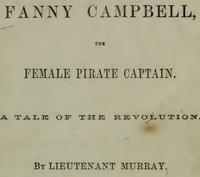
FANNY CAMPBELL, THE FEMALE PIRATE CAPTAIN

A Tale Of The Revolution

By Maturin Murray Ballou

E. D LONG & CO., BOOKSELLER

All books should have a preface, for the writer is sure to have something to communicate to the reader concerning the plot of the story or some subject relating to it which he cannot do in the tale. It is a sort of confidential communication between the author and reader, whom he takes by the buttonhole for a single moment, and endeavors to prepossess favorably towards his story. We are one of those who place great confidence in first impressions, and therefore design that the reader should at least commence our tale unprejudiced. He will see at a glance that our publisher has passed his judgment in commendation, by the superb manner in which he has issued the work, and the great expense incurred.

We have a few words to say concerning the subject matter of the tale. It is a very romantic one, but no more so than many others, the incidents of which occurred during the stirring times of the Revolution, and which have since received the sanction of history. We have been at some considerable expense in ferreting out the events of our tale, which have been cheerfully met by our liberal publisher.

_LYNN IN OLDEN TIMES. HIGH ROCK. THE FISHING HAMLET. THE STIRRING EVENTS THAT PRECEDED THE REVOLUTION. SOME OF OUR CHARACTERS. WILLIAM LOVELL. FANNY CAMPBELL. THE HEROINE. CAPTAIN RALPH BURNET OF THE ROYAL NAVY. A LOVER’S JEALOUSY._

|The town of Lynn, Massachusetts, situated up the Atlantic sea board, at a distance of some ten miles from the metropolis of New England, has been the locale of many an incident of a most romantic character. Indeed its history abounds with matter more akin to romance than fact. There are here the Pirate’s Cave, Lover’s Leap, the Robber’s Dungeon, all within a pistol shot of each other. The story of its early Indian history is also of a most interesting character, and altogether the place is one destined to be immortal from these causes alone.

In that part of the town known as ‘Wood End,’ there is an immense pile of stone rising perpendicularly on the side of a hill, fronting the ocean, known far and near by the name of High Rock. This granite mass is very peculiarly formed; the front rising abruptly nearly an hundred feet, while the back is deeply imbedded in the rising ground and the summit forms a plain level with the height of the hill and the adjoining plain in the rear. This spot has long been celebrated for the extended and beautiful prospect it affords. From its top which overlooks rock-bound Nahant in a Southerly direction, may be had a noble view of the Atlantic, and a breadth of coast nearly thirty miles in width. There is no spot upon our shores where the sea plays a wilder or more solemn dirge than on the rocky peninsula of Nahant; the long connecting beach is here a scene of angry commotion from the constant and heavy swells of the broad ocean.

At a distance of about ten miles in the South-West lies Boston. The eye always rests upon the dense smoke that enshrouds it first, piercing which, loom up the spires of its numerous churches, and towering above them all, the noble State House is distinctly seen. Turn still more to the West and you overlook the principal portion of the manufacturing town of Lynn, with its picturesque collection of white cottages and factories, appearing of miniature dimensions. Turn again towards the North West and a few miles beyond the town of Lynn, lies the thriving little village of Saugus. A full Northern view is one of woody beauty, being a field of forest tops of almost boundless extent. In the North-East through the opening hills and trees, a glimpse is had of the water in Salem harbor, while the city itself is hid from view, reminding one of the distant view of the Adriatic from the lofty Appenines, which rise from the very gates of the lovely city of Florence.

This is a slight glance at the extended prospect to be enjoyed by a visit to High Rock, at the present day, saying nothing of the pretty quiet little fishing village of Swampscot, and the panorama of sailing craft that always ornament the sea view.

Near the base of the rock there resided until a few years since the celebrated fortune-teller, known by the name of ‘Moll Pitcher,’ a soubriquet given her by the town’s people, her rightful name never having been ascertained. She lived to a remarkable old age, and to the day of her death the visitor who ‘crossed her palm with broad pieces,’ was sure to receive in return, some truthful or fictitious legend of the neighborhood. There are many among us to this day who remember with pleasure their visits to the strange old fortune-teller of Lynn, at the base of High Rock.

We have been thus particular in the description of this spot as it is the birth-place of two persons who will bear an important part in the tale we are about to relate, and partly, because we love this spot where we have whiled away many an hour of our boyish days. The peculiarities of one’s birth-place have much influence upon formation of the character and disposition. The associations that hang about us in childhood, have double weight upon our tender and susceptible minds at that time, to those of after days, when the character is more formed and matured, and the mind has become more stern and inflexible. It behoves us then to speak thus particularly of the birth-place and the associations of those who are to enact the principal characters in the drama which we relate.

There lived at the very base of High Rock about seventy years ago, a few families of the real puritanic stock, forming a little community of themselves. The occupation of the male portion of the hamlet was that of fishermen, while the time of the females was occupied in drying and preserving the fish and such other domestic labor as fell to their lot. The neighborhood, resembled in every particular, save that it was far less extensive, the present town of Swampscot, which is situated but about three or four miles from the very spot we are now describing, and whose inhabitants, a hardy and industrious people, are absolutely to this day ‘fishermen all.’

The date to which we refer was just at the commencement of the principal causes of difference between the colonies and the mother country; the time when shrewd and thoughtful men foretold the coming struggle between England and her North American dependances. Already had the opposition of the colonies to the odious Stamp Act, and more particularly the people of Massachusetts Bay, as Boston and the neighboring province was named, become so spirited and universal that the British Parliament had only the alternative to compel submission or repeal the act, which was at length reluctantly done. Yet the continued acts of arbitrary oppression enforced by parliament upon the people, such as the passing of laws that those of the colonists charged with capital crimes, should be sent to England to be tried by a jury of strangers, and like odious and unconstitutional enactments had driven the people to despair, and prepared them by degrees for the after startling events that caused all Europe to wonder and England herself to tremble!

The State Street massacre, the celebrated tea scene, in which the indignant inhabitants of Boston discharged three hundred and fifty chests of tea into the water of the bay, the thousand petty acts of tyranny practised by the soldiers of the crown; the Boston Port Bill blockading the harbor of Boston, all followed in quick succession, each being but the stepping stone to the great events to follow. These were the scenes at Lexington, Concord, Bunker Hill, and the many well-contested and bloody fields of the Revolution, until these United States of America were acknowledged to be _free and independent!_

The bold and adventurous characters of the men were affected as well by the times we have described, as by the hardy nature of their employment. The dangers that often times surrounded the homes of the females, gave rise to a stern and manly disposition even in those of the gentler sex who formed a part of the community, and altogether it was made up of stern and dauntless spirits. There was at the commencement of our tale about the year 1773, two families who occupied one spacious and comfortable cottage in the little neighborhood we have described. These were the families of Henry Campbell, and William Lovell, both fishermen, who sailed a staunch fishing craft together. Their families consisted of their wives and an only child each-William and Fanny, and it was the honest hope and promise of the parents that the children when arrived at a proper age should be united to each other. Nor were the betrothed on their part any way loth to such an agreement, for they loved each other with an affection that had grown with their years from earliest childhood. The course of true love seemed certain to run smooth with them at least, the old adage to the contrary notwithstanding.

William had been brought up almost entirely on board his father’s vessel, and he was as good a sailor as experience in this way could make. He was now nineteen, with a firm, vigorous, manly form, and an easy and gentlemanly bearing; his face when one came to be familiar with it, was decidedly handsome; showing forth a spirit that spurned all danger He was young, ardent and imaginative, and could but poorly brook the confinement of his father’s occupation, which engaged much of his time; his generous and ambitious mind aspiring to some higher calling than that of an humble fisherman He was but little on shore, save in the severe winters that come early and stay late in these northern latitudes; but then this season was looked forward to with pleasure by all. The long winter evenings were spent happily with Fanny, as she industriously pursued some female occupation, while he perhaps read aloud some instructive book or interesting tale, or they listened to some story of the old French and Indian war from their parents, who had been participators in their dangers and hardships. Then the subject of the present state of the prospects and interests of the colonies, and the oppression of the home government, were also fully discussed. Thus the time had passed away until William had reached his nineteenth year, when he resolved to make a bold push for fortune, as he said, and after obtaining permission which was reluctantly granted by his parents, he made arrangements to ship from Boston to some foreign clime as a sailor. A distant voyage in those days was an adventure indeed, and comparatively seldom undertaken.

William Lovell had been to Boston and shipped on board a merchant vessel for the West Indies and from thence to some more distant port, and had now returned to the cottage to put up his little bundle of clothes and bid farewell to his old companions and friends, and to say good-bye to his parents and her whom he loved with an affection that found no parallel among those with whom he had associated. It was this very love which had given birth to the ambition that actuated him, and the desire to acquire experience and pecuniary competency.

It was the evening before he was to sail, a mild summers night, when with Fanny he sought the summit of High rock. They seated themselves upon the rough stone seat, hewn from the solid rock by the hand of the red man, or perhaps by some race anterior even to them, and long and silently did both gaze off upon the distant sea. It was very calm, and the gentle waves but just kissed the rocky borders of Valiant and threw up little jets of silver spray about the black mass of Egg Bock. The moon seemed to be embroidering fancy patterns of silver lace upon the blue ocean, which scarcely moved, so gentle were the swells of its broad bosom under the fairy operation. This was some seventy years gone by, years of toil and labor, of joy and sorrow, years of smiling peace and angry war, three score and ten years ago, and yet within a twelve month I have sat upon that rock, aye, upon that very stone, and looked upon the same silvery sea, and viewed the same still, silvery scene; gazing on the same iron-bound shores, and the black and frowning mass of Egg Rock still there, as if placed a sentinel upon the shore, and yet sufficiently within the domain of Neptune to lead to the belief that it serves the hoary old god rather than the spirits of the land.

Fanny Campbell was a noble looking girl. She was none of your modern belles, delicate and ready to faint at the first sight of a reptile; no, Fanny could row a boat, shoot a panther, ride the wildest horse in the province, or do almost any brave and useful act. And Fanny could write poetry too, nay, start not gentle reader, her education was of no mean character. Such slight advantages as chance had thrown in her way had been improved to the utmost, and her parents finding her taste thus inclined, had humoured it to the extent of their limited means. Thus Fanny had received nearly every advantage attainable in those days. Once or twice in the course of the year, she was accustomed to pass some weeks at the house of a Reverend divine at Boston, with whom her father claimed some relationship. While here, the good man discovered her taste and inclination for study, and gave her such instructions as he was able, with the loan of books to amuse and strengthen her mind. By these means Fanny had actually obtained an excellent education at the time when we have introduced her to the reader; being but seventeen years of age. In her turn she had communicated her information to William Lovell and thus the two had possessed themselves of a degree of education and judgment that placed them above their friends in point of intelligence, and caused them to be looked up to in all matters of information, and scholarship.

‘Fanny,’ said William, ‘I shall be far away from you before another day has passed.’

‘Yes, many miles at sea, William’

‘But my heart will remain at home.’

‘And mine will leave it.’

‘In safe keeping, Fanny.’

‘I doubt it not, William.’

‘I find it even harder than I had supposed to leave you Fanny, now that the time has actually arrived.’

‘I do not think that we should regret it William, after all, for it will be the source of much improvement to you no doubt, and that you know is very desirable to us all. While I regret to think you are about to leave us I also envy you the experience you necessarily gain of the world, something that books cannot teach.’

‘You are a strange girl, Fanny.’

‘Do you love me any the less because I speak as I feel? William, I have no secrets from you.’

‘No, no, my dear girl, I only love thee the more, while I am still more surprised at thy brave and noble spirit, at the judgment and thought that characterises one of thy sex and tender years. By my soul thou shouldst have been a man, Fanny.’

‘Had I been, why, I would have done just that which thou art about to do--go abroad and see the world.’

‘And if you had a Fanny too at home whom you loved, would you go and leave her behind?’

‘Yes, because like you I should not know how dearly she loved me--perhaps.’

William pressed her hand and paused thoughtfully for a moment, then turning to her by his side resumed:

‘Would you have me give up this proposed enterprise? Say so, dearest, and I will relinquish it at once.’

‘Generous heart,’ said she placing her braided hands upon his shoulder first, and then laying her cheek upon them, ‘not for worlds. Though thy Fanny is over miserly in all that relates to thee, yet she would rather have thee follow thy inclination. No, no, I would have thee go.’

‘Nay, Fanny, I knew not until now how much I loved thee,’ said William Lovell, putting his arm about her waist and imprinting a kiss upon her smooth white forehead.

Fanny was not easily moved to tears, yet even she now brushed carelessly aside a single pearly drop that stole away from her deep blue eye. (Did you ever notice what depth there is to a blue eye, reader?)

‘You will often remember us here at home I know, William,’ said Fanny, and think how fervently we shall pray for your safe return’ And now the tear’s, apparently gathering fresh courage from the trembling voice of the noble girl, ventured to show themselves more boldly.

‘When I forget thee, dear Fanny, or any of the kind friends I leave behind, may Heaven forsake me.’

It was midnight when they separated, William was an honest and strictly conscientious youth; brought up after the strict code of puritanic faith, and as he was about to retire to rest, he bent his knee to Heaven and prayed long and fervently for blessings upon Fanny, his parents and all, and for guidance in his new undertaking. Then throwing himself upon his cot he was soon fast asleep.

Fanny too sought her chamber for the night but not to sleep, ah! no. She knelt to the throne of grace, and prayed for Heaven’s choicest blessings on him she loved, for his safe conduct upon the wide and trackless ocean. And oh! so fervent a prayer, and from one so devoted, so pure and innocent, must ever find audience in Heaven. As she cast off her neat and becoming homespun dress, she paused to brush away the gathering tears.

Have we described Fanny’s person, kind reader? No! What more fitting time than when clothed only in such a simple and modest covering as shall veil her charms.

Fanny Campbell was in height what would be called tall at the present day for a female, and yet she was not particularly so, for a healthy girl, who had never known a day of sickness, born and brought up in the free and invigorating air of the sea coast. Her limbs and person possessed that bewitching roundness, which, while it seems to indicate a tendency to _enbon-point_, yet is the farthest removed from an overfleshiness of habit her full heaving breast, her perfectly formed limbs, her round and dimpled arms, all spoke of a voluptuousness of person, and yet within the most delicate rule of beauty. A painter should have seen her there, her person modestly veiled yet displaying her form in most ravishing distinctness; her breast heaving with emotions, and her hands clasped and raised towards Heaven. Her features were after the Grecian school, with a coral lip that melted an anchorite. Where Fanny got those eyes from, Heaven only knows, they rivalled a Circassian’s. Nature seemed to have delighted in ornamenting her with every gift it might bestow. Her teeth were regular and white as pearls, and her hair was a very dark auburn, worn parted smoothly across her brow, and gathered in a modest snood behind the head, while it was easy to see by its very texture that if left to itself, it would have curled naturally.

Such was Fanny Campbell.

From its opening pages, Fanny Campbell, The Female Pirate Captain establishes a tension between romanticized local legend and revolutionary politics. The narrator lingers on Lynn, Massachusetts's "Pirate's Cave, Lover's Leap, the Robber's Dungeon" as sites that blend fact with folklore, then pivots to the "stirring events that preceded the Revolution." This dual framing—the picturesque and the political—shapes the entire tale. The preface further signals the author's confidence in his publisher's "superb manner" of issuing the work, a self-conscious nod to the book's material production that colors the reader's expectations.

Disguise and Command

Fanny Campbell's authority rests on a sustained act of cross-dressing, a device the text treats with matter-of-fact drama. When a guard hesitates to obey her order to unbind a prisoner, she rises and draws her "naked sword," demanding, "Do I command this vessel?" The scene hinges on the visible symbol of the sword—an object that, in her hands, overrides the crew's doubt. The narrator notes that Lovell and Herbert were "unprepared for this, and did not venture a word," suggesting that her command is won through theatrical force rather than inherent rank. The prisoner's later astonishment at being freed underscores how the disguise enables a moral authority that her biological identity would not permit.

Debating Loyalty Under Bondage

The interrogation of the British prisoner reveals the novel's central ideological conflict. Fanny challenges his claim that "the enemies of my king are the enemies of God" by listing colonial grievances: "sanctuarys defiled, of homes made desolate, the prostration of trade." Her speech is structured as a series of rhetorical questions, each building toward the assertion that "our English origin" demands resistance to tyranny. The prisoner, initially defiant, shifts to thoughtful silence after hearing her arguments. This exchange is notable for its even-handedness: the prisoner is given a dignified voice, and Fanny's victory comes through persuasion rather than force. The scene models the kind of reasoned debate the novel seems to endorse, even within a genre prone to action.

Setting as Character

The novel's geography is thick with symbolic weight. High Rock, described as a "granite mass" rising "nearly an hundred feet" with a summit level to the adjoining plain, serves as both a lookout and a stage. The narrator insists that Lynn's history "abounds with matter more akin to romance than fact," and the landmarks—Pirate's Cave, Lover's Leap—are invoked as ready-made backdrops for adventure. This treatment of place does more than provide local color; it frames the Revolution itself as a romantic episode, continuous with the area's legendary past. The careful description of the rock's formation—"the front rising abruptly ... while the back is deeply imbedded"—mirrors the dual nature of the heroine, who presents one face to the world while concealing another.

Readers should attend to how the novel balances its sensational premise—a woman commanding a pirate ship—with its earnest political arguments. The excerpts suggest that Fanny's authority is repeatedly tested and reasserted through dialogue and gesture, not merely through action. The preface's boast about the publisher's expense also invites scrutiny of how the book markets itself as a luxury object while telling a story of rebellion. These tensions between surface and substance, loyalty and liberty, are the threads that hold the tale together.

Fanny’s quiet defiance stayed with me long after I closed the book—how she led without losing herself. That same lingering ache for buried loyalty and hard choices followed me into The Pirate of Panama: A Tale of the Fight for Buried Treasure — Reading Companion. It felt less like a new story and more like an old friend remembering the sea with me.

Scarlett Campbell
1 month ago

Anthony Jones
1 month ago

4
4 out of 5 (2 User reviews )

Add a Review

Your Rating *
  • ...
    Terri Rhodes - 1 month ago
    Fanny Campbell The Female Pirate Captain A Tale Of The Revolution is an entertaining adventure with an intriguing protagonist. The premise is fascinating, and Fanny's character is certainly memorable. However, the plot is somewhat far-fetched at times, and the pacing fluctuates between slow and frenetic. The historical backdrop is interesting, but the dialogue can feel dated. An enjoyable read for those who like swashbuckling stories with a feminist twist.

  • ...
    Ryan Linda Kim - 4 weeks ago
    Fanny Campbell The Female Pirate Captain A Tale Of The Revolution is a groundbreaking historical novel that features a strong, independent heroine ahead of her time. The story is packed with adventure, romance, and patriotic fervor, and Fanny's journey from a modest farm girl to a daring pirate captain is truly inspiring. The writing is lively and engaging, making this a thrilling read from start to finish. Highly recommended!

  • ...
    David Gordon - 1 week ago
    Fanny Campbell The Female Pirate Captain A Tale Of The Revolution is a disjointed and implausible tale that fails to do justice to its fascinating subject. The writing is amateurish, with wooden dialogue and flat characterizations. Fanny herself, despite her potential, is inconsistently written and not believable as a pirate captain. The plot relies too heavily on coincidences and contrived situations. This book reads like a rough draft that needed serious editing.


Reader reflection

Before you leave, reflect on the book

Use these questions to collect your thoughts before moving on.

Your progress 0 / 10
1

Have you finished this book?

2

How did the book work for you overall?

3

Is this a title you would suggest to others?

4

How much effort did this book require?

Related eBooks