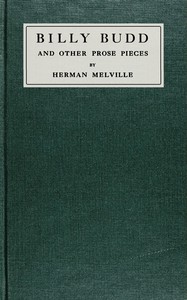
Billy Budd — A Reader’s Guide
Edition facts
The catalog record for Billy Budd — A Reader’s Guide provides practical reading context through 122,873 words, 8 hr 55 min estimated reading time, and 49 detected text sections.
The text analysis averages about 21.9 words per sentence, while the detected sections provide another way to judge how the source is divided.
Project Gutenberg metadata also associates the work with “Sea stories,” connecting these edition facts with the source record’s subject description.
Calculated from edition completeness, EPUB availability, text structure and catalogue metadata. Not a user rating.
How this score is calculated
- Description quality20 pts
- Title & short description10 pts
- Source metadata20 pts
- Text length15 pts
- Chapters / structure15 pts
- EPUB file integrity20 pts
Total of 100 points, scaled to a 2.5-5.0 range. Editions with an empty description or a missing EPUB file are not scored.
Read the Text
nced by naming his ships after Voltaire, Diderot, and so forth.
But now when the boat swept under the merchantman’s stern, and officer and oarsmen were noting, some bitterly and others with a grin, the name emblazoned there; just then it was that the new recruit jumped up from the bow where the coxswain had directed him to sit, and, waving his hat to his silent shipmates sorrowfully looking over at him from the taffrail, bade the lads a genial good-bye. Then making a salutation as to the ship herself, ‘And good-bye to you too, old _Rights-of-Man_!’
‘Down, sir,’ roared the Lieutenant, instantly assuming all the rigour of his rank, though with difficulty repressing a smile.
To be sure, Billy’s action was a terrible breach of naval decorum. But in that decorum he had never been instructed; in consideration of which the Lieutenant would hardly have been so energetic in reproof but for the concluding farewell to the ship. This he rather took as meant to convey a covert sally on the new recruit’s part, a sly slur at impressment in general, and that of himself in especial. And yet, more likely, if satire it was in effect, it was hardly so by intention, for Billy, though happily endowed with the gaiety of high health, youth, and a free heart, was yet by no means of a satirical turn. The will to it and the sinister dexterity were alike wanting. To deal in double meaning and insinuations of any sort was quite foreign to his nature.
As to his enforced enlistment, that he seemed to take pretty much as he was wont to take any vicissitudes of weather. Like the animals, though no philosopher he was, without knowing it, practically a fatalist. And, it may be, that he rather liked this adventurous turn in his affairs which promised an opening into novel scenes and martial excitements.
Aboard the _Indomitable_ our merchant-sailor was forthwith rated as an able seaman, and assigned to the starboard watch of the foretop. He was soon at home in the service, not at all disliked for his unpretentious good looks, and a sort of genial happy-go-lucky air. No merrier man in his mess; in marked contrast to certain other individuals included like himself among the impressed portion of the ship’s company; for these when not actively employed were sometimes, and more particularly in the last dog-watch when the drawing near of twilight induced revery, apt to fall into a saddish mood which in some partook of sullenness. But they were not so young as our foretopman, and no few of them must have known a hearth of some sort, others may have had wives and children left, too probably, in uncertain circumstances, and hardly any but must have acknowledged kith and kin; while for Billy, as will shortly be seen, his entire family was practically invested in himself.
------------------------------------------------------------------------
Though our new-made foretopman was well received in the top and on the gun-decks, hardly here was he that cynosure he had previously been among those minor ships’ companies of the merchant marine, with which companies only had he hitherto consorted.
He was young; and despite his all but fully developed frame, in aspect looked even younger than he really was. This was owing to a lingering adolescent expression in the as yet smooth face, all but feminine in purity of natural complexion, but where, thanks to his sea-going, the lily was quite suppressed, and the rose had some ado visibly to flush through the tan.
To one essentially such a novice in the complexities of factitious life, the abrupt transition from his former and simpler sphere to the ampler and more knowing world of a great warship--this might well have abashed him had there been any conceit or vanity in his composition. Among her miscellaneous multitude, the _Indomitable_ mustered several individuals who, however inferior in grade, were of no common natural stamp, sailors more signally susceptive of that air which continuous martial discipline and repeated presence in battle can in some degree impart even to the average man. As the _Handsome Sailor_ Billy Budd’s position aboard the seventy-four was something analogous to that of a rustic beauty transplanted from the provinces and brought into competition with the high-born dames of the court. But this change of circumstances he scarce noted. As little did he observe that something about him provoked an ambiguous smile in one or two harder faces among the blue-jackets. Nor less unaware was he of the peculiar favourable effect his person and demeanour had upon the more intelligent gentlemen of the quarter-deck. Nor could this well have been otherwise. Cast in a mould peculiar to the finest physical examples of those Englishmen in whom the Saxon strain would seem not at all to partake of any Norman or other admixture, he showed in face that humane look of reposeful good-nature which the Greek sculptor in some instances gave to his heroic strong man, Hercules. But this again was subtly modified by another and pervasive quality. The ear, small and shapely, the arch of the foot, the curve in mouth and nostril, even the indurated hand dyed to the orange-tawny of the toucan’s bill, a hand telling of the halyards and tar-buckets; but, above all, something in the mobile expression, and every chance attitude and movement, something suggestive of a mother eminently favoured by Love and the Graces; all this strangely indicated a lineage in direct contradiction to his lot. The mysteriousness here, became less mysterious through a matter of fact elicited when Billy at the capstan was being formally mustered into the service. Asked by the officer, a small, brisk little gentleman as it chanced, among other questions, his place of birth, he replied, ‘Please, sir, I don’t know.’
‘Don’t know where you were born? Who was your father?’
Struck by the straightforward simplicity of these replies, the officer next asked, ‘Do you know anything about your beginning?’
‘No, sir. But I have heard that I was found in a pretty silk-lined basket hanging one morning from the knocker of a good man’s door in Bristol.’
‘_Found_, say you? Well,’ throwing back his head, and looking up and down the new recruit--‘well, it turns out to have been a pretty good find. Hope they’ll find some more like you, my man; the fleet sadly needs them.’
Yes, Billy Budd was a foundling, a presumable by-blow, and, evidently, no ignoble one. Noble descent was as evident in him as in a blood horse.
For the rest, with little or no sharpness of faculty or any trace of the wisdom of the serpent, nor yet quite a dove, he possessed a certain degree of intelligence along with the unconventional rectitude of a sound human creature--one to whom not yet has been proffered the questionable apple of knowledge. He was illiterate; he could not read, but he could sing, and like the illiterate nightingale was sometimes the composer of his own song.
Of self-consciousness he seemed to have little or none, or about as much as we may reasonably impute to a dog of St. Bernard’s breed.
Habitually being with the elements and knowing little more of the land than as a beach, or, rather, that portion of the terraqueous globe providentially set apart for dance-houses, doxies and tapsters, in short, what sailors call a ‘fiddlers’ green,’ his simple nature remained unsophisticated by those moral obliquities which are not in every case incomparable with that manufacturable thing known as respectability. But are sailor frequenters of fiddlers’ greens without vices? No; but less often than with landsmen do their vices, so-called, partake of crookedness of heart, seeming less to proceed from viciousness than exuberance of vitality after long restraint, frank manifestations in accordance with natural law. By his original constitution, aided by the co-operating influences of his lot, Billy in many respects was little more than a sort of upright barbarian, much such perhaps as Adam presumably might have been ere the urbane Serpent wriggled himself into his company.
And here be it submitted that, apparently going to corroborate the doctrine of man’s fall (a doctrine now popularly ignored), it is observable that where certain virtues pristine and unadulterate peculiarly characterise anybody in the external uniform of civilisation, they will upon scrutiny seem not to be derived from custom or convention but rather to be out of keeping with these, as if indeed exceptionally transmitted from a period prior to Cain’s city and citified man. The character marked by such qualities has to an unvitiated taste an untampered-with flavour like that of berries, while the man thoroughly civilised, even in a fair specimen of the breed, has to the same moral palate a questionable smack as of a compounded wine. To any stray inheritor of these primitive qualities found, like Caspar Hauser, wandering dazed in any Christian capital of our time, the poet’s famous invocation, near two thousand years ago, of the good rustic out of his latitude in the Rome of the Cæsars, still appropriately holds:--
‘Faithful in word and thought, What hast Thee, Fabian, to the city brought.’
Though our Handsome Sailor had as much of masculine beauty as one can expect anywhere to see; nevertheless, like the beautiful woman in one of Hawthorne’s minor tales, there was just one thing amiss in him. No visible blemish, indeed, as with the lady; no, but an occasional liability to a vocal defect. Though in the hour of elemental uproar or peril, he was everything that a sailor should be, yet under sudden provocation of strong heart-feeling his voice, otherwise singularly musical, as if expressive of the harmony within, was apt to develop an organic hesitancy,--in fact, more or less of a stutter or even worse. In this particular Billy was a striking instance that the arch-interpreter, the envious marplot of Eden still has more or less to do with every human consignment to this planet of earth. In every case, one way or another, he is sure to slip in his little card, as much as to remind us--I too have a hand here.
The avowal of such an imperfection in the Handsome Sailor should be evidence not alone that he is not presented as a conventional hero, but also that the story in which he is the main figure is no romance.
------------------------------------------------------------------------
At the time of Billy Budd’s arbitrary enlistment into the _Indomitable_ that ship was on her way to join the Mediterranean fleet. No long time elapsed before the junction was effected. As one of that fleet the seventy-four participated in its movements, though at times on account of her superior sailing qualities, in the absence of frigates, dispatched on separate duty as a scout, and at times on less temporary service. But with all this the story has little concernment, restricted as it is to the inner life of one particular ship and the career of an individual sailor.
It was the summer of 1797. In the April of that year had occurred the commotion at Spithead, followed in May by a second and yet more serious outbreak in the fleet at the Nore. The latter is known, and without exaggeration in the epithet, as the Great Mutiny. It was indeed a demonstration more menacing to England than the contemporary manifestos and conquering and proselytising armies of the French Directory.
To the Empire, the Nore Mutiny was what a strike in the fire-brigade would be to London threatened by general arson. In a crisis when the Kingdom might well have anticipated the famous signal that some years later published along the naval line of battle what it was that upon occasion England expected of Englishmen; _that_ was the time when at the mast-heads of the three-deckers and seventy-fours moored in her own roadstead--a fleet, the right arm of a Power then all but the sole free conservative one of the Old World, the blue-jackets, to be numbered by thousands, ran up with hurrahs the British colours with the union and cross wiped out; by that cancellation transmuting the flag of founded law and freedom defined, into the enemy’s red meteor of unbridled and unbounded revolt. Reasonable discontent growing out of practical grievances in the fleet had been ignited into irrational combustion as by live cinders blown across the Channel from France in flames.
The event converted into irony for a time those spirited strains of Dibdin--as a song-writer no mean auxiliary to the English Government--at this European conjuncture, strains celebrating, among other things, the patriotic devotion of the British tar--
‘And as for my life, ’tis the King’s!’
Such an episode in the Island’s grand naval story her naval historians naturally abridge; one of them (G. P. R. James) candidly acknowledging that fain would he pass it over did not ‘impartiality forbid fastidiousness.’ And yet his mention is less a narration than a reference, having to do hardly at all with details. Nor are these readily to be found in the libraries. Like some other events in every age befalling states everywhere, including America, the Great Mutiny was of such character that national pride along with views of policy would fain shade it off into the historical background. Such events cannot be ignored, but there is a considerate way of historically treating them. If a well-constituted individual refrains from blazoning aught amiss or calamitous in his family, a nation in the like circumstance may without reproach be equally discreet.
Though after parleyings between Government and the ringleaders, and concessions by the former as to some glaring abuses, the first uprising--that at Spithead--with difficulty was put down, or matters for a time pacified; yet at the Nore the unforeseen renewal of insurrection on a yet larger scale, and emphasised in the conferences that ensued by demands deemed by the authorities not only inadmissible but aggressively insolent, indicated, if the red flag did not sufficiently do so, what was the spirit animating the men. Final suppression, however, there was; but only made possible perhaps by the unswerving loyalty of the marine corps, and a voluntary resumption of loyalty among influential sections of the crews. To some extent the Nore Mutiny may be regarded as analogous to the distempering irruption of contagious fever in a frame constitutionally sound, and which anon throws it off.
At all events, among these thousands of mutineers were some of the tars who not so very long afterwards--whether wholly prompted thereto by patriotism, or pugnacious instinct, or by both--helped to win a coronet for Nelson at the Nile, and the naval crown of crowns for him at Trafalgar. To the mutineers those battles, and especially Trafalgar, were a plenary absolution, and a grand one; for that which goes to make up scenic naval display is heroic magnificence in arms. Those battles, especially Trafalgar, stand unmatched in human annals.
------------------------------------------------------------------------
Concerning ‘The greatest sailor since the world began.’--
In this matter of writing, resolve as one may to keep to the main road, some by-paths have an enticement not readily to be withstood. Beckoned by the genius of Nelson I am going to err into such a by-path. If the reader will keep me company I shall be glad. At the least we can promise ourselves that pleasure which is wickedly said to be in sinning, for a literary sin the divergence will be.
Very likely it is no new remark that the inventions of our time have at last brought about a change in sea warfare in degree corresponding to the revolution in all warfare effected by the original introduction from China into Europe of gunpowder. The first European firearm, a clumsy contrivance, was, as is well known, scouted by no few of the knights as a base implement, good enough peradventure for weavers too craven to stand up crossing steel with steel in frank fight. But as ashore knightly valour, though shorn of its blazonry, did not cease with the knights, neither on the seas, though nowadays in encounters there a certain kind of displayed gallantry be fallen out of date as hardly applicable under changed circumstances, did the nobler qualities of such naval magnates as Don John of Austria, Doria, Van Tromp, Jean Bart, the long line of British admirals and the American Decaturs of 1812 become obsolete with their wooden walls.
Nevertheless, to anybody who can hold the Present at its worth without being inappreciative of the Past, it may be forgiven, if to such an one the solitary old hulk at Portsmouth, Nelson’s _Victory_, seems to float there, not alone as the decaying monument of a fame incorruptible, but also as a poetic reproach, softened by its picturesqueness, to the _Monitors_ and yet mightier hulls of the European ironclads. And this not altogether because such craft are unsightly, unavoidably lacking the symmetry and grand lines of the old battle-ships, but equally for other reasons.
There are some, perhaps, who while not altogether inaccessible to that poetic reproach just alluded to, may yet on behalf of the new order be disposed to parry it; and this to the extent of iconoclasm, if need be. For example, prompted by the sight of the star inserted in the _Victory’s_ deck designating the spot where the Great Sailor fell, these martial utilitarians may suggest considerations implying that Nelson’s ornate publication of his person in battle was not only unnecessary, but not military, nay, savoured of foolhardiness and vanity. They may add, too, that at Trafalgar it was in effect nothing less than a challenge to death; and death came; and that but for his bravado the victorious admiral might possibly have survived the battle, and so, instead of having his sagacious dying injunctions overruled by his immediate successor in command, he himself when the contest was decided might have brought his shattered fleet to anchor, a proceeding which might have averted the deplorable loss of life by shipwreck in the elemental tempest that followed the martial one.
Well, should we set aside the more than disputable point whether for various reasons it was possible to anchor the fleet, then plausibly enough the Bethamites of war may urge the above.
But he _might have been_ is but boggy ground to build on. And certainly in foresight as to the larger issue of an encounter, and anxious preparations for it--buoying the deadly way and mapping it out, as at Copenhagen--few commanders have been so painstakingly circumspect as this reckless declarer of his person in fight.
Personal prudence, even when dictated by quite other than selfish considerations, is surely no special virtue in a military man; while an excessive love of glory, exercising to the uttermost the honest heart-felt sense of duty, is the first. If the name _Wellington_ is not so much of a trumpet to the blood as the simpler name _Nelson_, the reason for this may perhaps be inferred from the above. Alfred in his funeral ode on the victor of Waterloo ventures not to call him the greatest soldier of all time, though in the same ode he invokes Nelson as ‘the greatest sailor since the world began.’
At Trafalgar Nelson on the brink of opening the fight sat down and wrote his last brief will and testament. If under the presentiment of the most magnificent of all victories, to be crowned by his own glorious death, a sort of priestly motive led him to dress his person in the jewelled vouchers of his own shining deeds; if thus to have adorned himself for the altar and the sacrifice were indeed vainglory, then affectation and fustian is each truly heroic line in the great epics and dramas, since in such lines the poet but embodies in verse those exaltations of sentiment that a nature like Nelson, the opportunity being given, vitalises into acts.
------------------------------------------------------------------------
The outbreak at the Nore was put down. But not every grievance was redressed. If the contractors, for example, were no longer permitted to ply some practices peculiar to their tribe everywhere, such as providing shoddy cloth, rations not sound, or false in the measure; not the less impressment, for one thing, went on. By custom sanctioned for centuries, and judicially maintained by a Lord Chancellor as late as Mansfield, that mode of manning the fleet, a mode now fallen into a sort of abeyance but never formally renounced, it was not practicable to give up in those years. Its abrogation would have crippled the indispensable fleet, one wholly under canvas, no steam-power, its innumerable sails and thousands of cannon, everything in short, worked by muscle alone; a fleet the more insatiate in demand for men, because then multiplying its ships of all grades against contingencies present and to come of the convulsed Continent.
Melville's late prose, as represented in this volume, is marked by a distinctive tension between formal, almost legalistic syntax and sudden, colloquial eruptions. In 'Billy Budd,' the narrator frequently adopts a measured, hypotactic style—long clauses linked by semicolons and dashes—only to break into sharp, imperative commands or exclamations. This oscillation creates a rhythm of control and disruption that mirrors the thematic conflicts of authority and impulse. The same pattern appears in the shorter pieces: 'Poor Man's Pudding and Rich Man's Crumbs' shifts from descriptive exposition to the bellowed orders of a red-gowned official, while 'The Happy Failure' juxtaposes the uncle's deliberate speech with Yorpy's strained exclamations. These shifts are not merely stylistic tics; they signal moments of psychological or social rupture.
Syntactic Swells and Abrupt Commands
The narrative voice in 'Billy Budd' often builds through elaborate, periodic sentences that accumulate subordinate clauses before arriving at a main verb. For instance, the description of the mob in 'Poor Man's Pudding' uses a cascade of participles and relative clauses: 'They surged against the tables, broke through all barriers, and billowed over the hall—their bare tossed arms like the dashed ribs of a wreck.' Yet this swelling prose is repeatedly punctured by direct, forceful commands: 'This way, this way! stick like a bee to my back,' or 'Wedge—wedge in—quick—there goes your bunged hat—never stop for your coat-tail—hit that man—strike him down!' The effect is a kind of syntactic violence, where the orderly flow of description is shattered by urgent, fragmented directives. This pattern recurs across the collection, suggesting a deliberate technique to dramatize moments of crisis or confrontation.
The Interplay of Formal Diction and Vernacular
Melville's late style frequently juxtaposes elevated, almost archaic vocabulary with plain, even coarse, speech. In 'Billy Budd,' the narrator might describe a scene with words like 'contumelious' or 'impotent fury,' while characters speak in blunt, imperative tones. The same contrast appears in 'The Happy Failure,' where the uncle's elaborate plans are described in formal language, but his exclamation 'Come, hurry, stump along, Yorpy!' introduces a homely, physical urgency. This lexical range creates a layered texture: the formal diction suggests a detached, analytical perspective, while the vernacular pulls the reader into immediate, embodied experience. The effect is not merely decorative; it reflects a world where high ideals and brutal realities coexist, and where language itself becomes a site of conflict between order and chaos.
Pacing Through Parenthetical Interruption
A notable feature of Melville's narrative pacing is the use of parenthetical asides and dashes to interrupt the main clause, creating a staccato rhythm that mimics hesitation or sudden insight. In the excerpt from 'Poor Man's Pudding,' the guide's speech is broken by dashes: 'There, now, sir,' said the honest fellow, as he put me into the hack, and tucked in me and my rags, 'when you get back to your own country, you can say you have witnessed the greatest of all England's noble charities. Of course, you will make reasonable allowances for the unavoidable jam.' The dash after 'rags' and the parenthetical 'Of course' slow the sentence, drawing attention to the ironic gap between the guide's reassurance and the narrator's tattered state. Similarly, in 'Billy Budd,' dashes frequently set off explanatory clauses or sudden shifts in tone, controlling the reader's pace and emphasizing key details. This technique gives the prose a conversational, almost improvisational quality, even within otherwise formal passages.
Readers approaching this volume should attend to the cadence of Melville's sentences—the way he builds and breaks rhythm through syntax, diction, and punctuation. The shifts between formal exposition and colloquial interruption are not random; they are structural signals that highlight moments of tension, irony, or psychological depth. By observing these patterns, one can trace the author's late stylistic development, where control and disruption are held in precarious balance.
I often set down my spectacles over that old reader’s guide, struck by Melville’s sudden, human jolt mid-sentence. It reminds me of the salt-worn voices in The Wind-Jammers — Themes and Context, where the formal log yields to a sailor’s muttered aside. Both keep that same discreet pulse—a quiet break in decorum, like a friend finishing your thought.

Harper Moore
1 month agoTake a moment to reflect on this book
Create a short personal record of your experience with this book.
James Ramirez
2 weeks ago